I don’t notice any difference in reliability with mine at all and I have quite a few M&P .45’s. What is your definition of a “combat” pistol"? People use that phrase without defining what they mean. To me there are military combat pistols and civilian/LEO combat pistols. In the latter, ease of firing fast accurate shots, reliability, and maintainability are important as you do not have an armorer providing them for you as in the military. Reliability is important in either case but especially in the military where weapons are often in rough conditions. Availability of spare parts is key. HK loses big time here. So does the XD and it has too many bells and whistles I don’t want or need that provide potential points of failure. Having carried a variety of weapons in some pretty awful conditions I would be fine with being issued either the M&P .45 or HK 45 but not the XD. 7,000 rounds without cleaning? Why?
Well HK designed this as a replacement for the US Military side arm as I am sure you know. It was designed as a combat weapon meaning it will work in all conditions, it will work dirty, shoot all types of ammo etc. In contrast to a gun like a 1911 that will most likely have a better trigger since it is single action then a 1911, possibly less muzzle flip since it is an all steel pistol etc. However modern day highly tuned 1911 pistols will not work in conditions that the HK45 will. I would place a Glock in the same combat weapon category as the HK. They work all the time!
I hate cleaning guns and it is interesting to see just how far it can go before it develops any issues. I tend to clean most my weapons except for a carry gun once a year.
They did not initially design it for the military but made changes to it later to try for the contract. I would think M&P also hoped to try for it but I don’t the history of that. I’m sure others here do. I have a gun cleaning fetish that I don’t try to deny borne from years of cleaning/lubing weapons in the military. Plus I do enjoy it. Any time I hear “combat” weapon I have to say I assume that to mean military weapon which means they go through things that no civilian or LEO weapon ever will and they do it repeatedly for years in the hands of many different people. The Glock seems to be doing well in Iraq/Stan from what I hear.
Have you been following Greg Bells torture test of his HK45 over on HKpro? He also did one on the P2000 and both of them have been awesome.
PS also Larry Vickers had a large roll in the design of the HK45 and that alone should give the weapon some added credibility.
dtibbals,
The HK45 and M&P45 are both good pistols. Personally I prefer the M&P, as I shoot it better and I can purchase 2 M&P’s for the price of one HK45…
You might also wish to read what Larry Vickers has written on this topic:
“IMO the 2 best new .45 service pistols on the market are the M&P 45 and the HK 45 - they are in a league of their own. Both are easily tweaked for optimum performance and are accurate and reliable right out of the box - for the money I think the M&P is a better choice but the HK 45 is a more bomb proof pistol - I know first hand what went into the testing and development of it - for a service pistol it is as rugged and reliable as any 45 made today.”
Larry has also pointed out some problems with the HK45 that you might wish to review: https://www.m4carbine.net/showthread.php?p=151649#post151649
I don’t doubt for a moment that you can shoot the M&P or Glocks best, however my point was that too many people dismiss outstanding pistols such as SIGs and HKs based off of a perception of the ill effects of a higher bore axis without actually shooting them. Frankly, few people have the money to own and truly experiment with all sorts of different pistols. However, I would vehemently disagree that a low bore axis is going to automatically mean one will shoot a pistol better or faster. I can shoot SIGs and HKs faster and more accurately than Glocks. I can shoot an HK USPc .45 faster than any 1911. All despite their higher bore axes. Yes, anecdotal. The IDPA circuit I shot with for the last 4 years was dominated by high bore axis pistols in SSP. ALL of the top shooters were running SIGs. CDP was dominated by 1911 of course but we all remember the year that Ernest Langdon dominated the 1911s with a SIG P220 destroying myths that high bore axis and DA/SA triggers were slow and inaccurate. One can choose to dismiss these facts but they’d be wrong. And just because gunsmiths provide a service doesn’t mean that it’s always better. Many gunsmiths don’t even shoot that much. They are running a business and supply a service to the customer’s request or what the market bears. Some, not all. The fact is that there are far too many other factors to contribute to fast and accurate shooting than can be boiled to “low bore axis equals faster shooting.” The angle of muzzle rise is not directly related to how fast a pistol can be shot. I will concede that the M&P series of pistols have many very favorable shooting qualities packaged into a single platform and shoot very well for a great many people. Regardless, even if one could statistically prove that an M&P is some mircosecond or two faster and better shooting than an HK45 would be moot. If all one can do is obsessively measure their splits on a timer or at an IDPA/USPSA match then so be it. Many, including myself, will choose an HK45 over an M&P because HK has built a long standing reputation for engineering and building weapons intended to be fought with, not played with, using the best materials possible, dare I say “without compromise,” and even at the expense of a competitive market that has only driven prices down, and usually quality down with it.
Tim
No pistols are “bomb proof”. They aren’t even “fed proof”. Heck, they aren’t even “child proof” yet. Obama may take care of that?
HKs (USPc and P2000) in federal service (ICE, CBP, TSA) have had probs here and there. Rust probs, reliability probs, and breakage probs. Not 45s, but very similar guns.
M&Ps have not been in service long enough for a fair comparison, and there have been issues, but they look good so far. Could be more gremlins waiting to pounce on them too, who knows?
Stuff happens. Beretta slides did not break during final M9 testing, SIG frames did, and look what happened later? Not likely to need to, but you can replace the front/rear frame rails and ejector on the M&P, not the HKs. Remember the great Glock frame (rail) “upgrade” a few yrs ago? Local SD only had to replace 230 of theirs. Wouldn’t that have been fun w several hundred thousand service pistols?
And S&W designed the M&P45 for the exact same reason. Not sure I understand the point.
It was designed as a combat weapon meaning it will work in all conditions, it will work dirty, shoot all types of ammo etc.
What popular LE/mil guns do you think were not designed with that in mind?
I hate cleaning guns and it is interesting to see just how far it can go before it develops any issues.
Can’t argue with that:
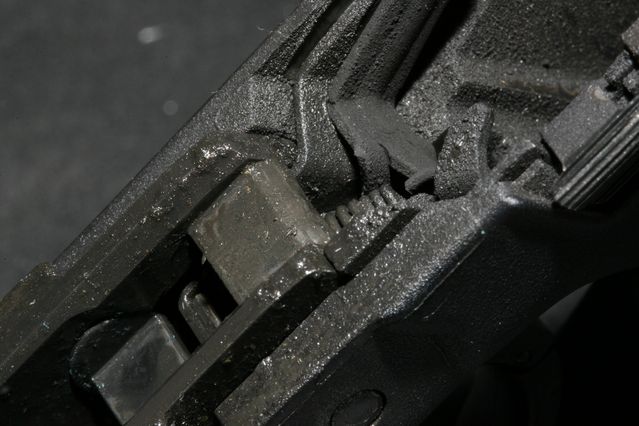
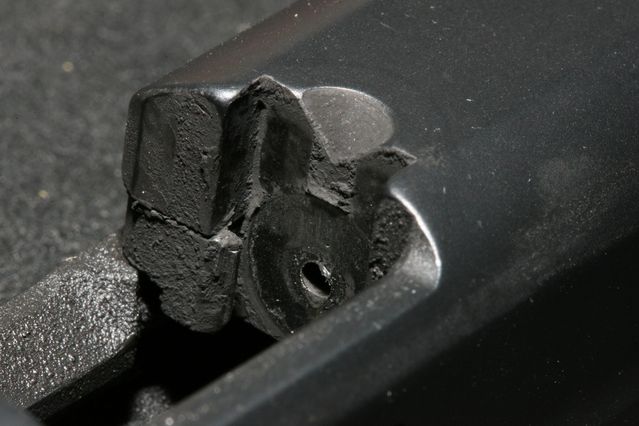
Agreed 100%. Almost every IDPA or USPSA trophy I’ve got was won with either a Beretta (moderately high bore axis) or SIG (very high bore axis).
Does a lower bore axis help control shot recovery? Sure.
Weight in the frame helps, too. Funny that the Glock/Smith/H&K folks forget that part. 
The reality is that there are many factors that affect how well a gun helps the shooter recover from shot to shot. If you can’t shoot a SIG or H&K without the gun getting away from you in recoil, you’ve got a technique problem. Fix that problem, and you’ll not only shoot the SIG/H&K better, you’ll shoot your “low bore axis” guns better, too.
And Tim, I always respect what you write but dude if I send you a dollar will you start using paragraphs?
As you know a number of the high bore axis pistols we are talking about, such as the Hk 45 and Sig have a high bore axis and a light receiver so they are top heavy. I am also not referring to people like most of us who post here who I would hope shoot and train quite a lot. Most people don’t and for most people I think a low bore axis is a good thing.
I love a low bore axis on a pistol. Love it!  Doesn’t mean I don’t shoot high bore axis pistols well which is why I have more than a few of them. Also there are plenty of people, considered legends in hand gun shooting, Col. Cooper and so on, who reference a low bore axis as a desirable trait in a handgun.
There’s also the issue of where/how the slide force gets delivered into the frame and into the gun. With a SIG, for example, the force occurs well below the bore line and almost as low in the hand as you’d get shooting a Glock/M&P/etc.
I am also not referring to people like most of us who post here who I would hope shoot and train quite a lot. Most people don’t and for most people I think a low bore axis is a good thing.
I would have to disagree. For someone with minimal training, the bore axis is going to be a very minor factor in shot recovery. Only once grip, visual reference, and proper trigger manipulation skills have reached serious proficiency will things like bore axis make a meaningful difference in actual performance.
I really like the HK45. It is a great shooting, reliable gun. I have 13k through mine without a hiccup. I have taken it to a three classes and it has performed admirably.  Based on what I have seen I doubt you can buy a more robust .45.
Although this is my current favorite .45…

Greg,
Your a bit further then me on round count on the HK45 but I am trying to catch you when I have time! Mine is my favorite as well. What is your lever action? I have been looking at Marlin Guide guns 18" and maybe cut it down to the 16.5". I have it down to the 45/70 or 450 Marlin. The 45/70 has been around for ever but the 450 Marlin is pretty damn impressive.
Dave
PS Nice to see you here as well as HKpro.
Hey,
Yeah, I have been slack on my HK45 shooting. I have soooo much brass to reload.
The Marlin is a 45/70 guide gun cut down by Brockman’s. They also brought the tube out to 5+1. It is my favorite rifle.
My “technique’” if you can call it that is to go ahead and let the muzzle rise and drop right back down for another shot. Works for me and doesn’t seem to slow me down much if any. What do you recommend?
Without seeing you shoot, it’s impossible to diagnose. But shot recovery technique certainly involves a lot more than “let it go up and watch it come back down.”
I understand your partly tongue in cheek here but I don’t actually watch it go up and down. It’s just normal for me to let it pop up while I keep my eye on the target and reacquire the front sight when it comes down. One thing I don’t try to do is keep a tight hold on the pistol to keep it from moving. I used to some time ago but that just made my hands shake after a while.
Mr. Vickers,
Would you say that the same can be said of the P2000? Did HK put the same effort into that platform?
I was and am a huge USP fan, and may add a P2000 to the battery soon. I live in CA, so for now I think that the HK45 is of limits.
Just curious. I can’t think of anybody more “plugged into” H&K than you.
Apologies for minor thread drift. Mods, no hard feelings if this post needs to be pruned.
We’re getting far afield of the original thread, but I’ll just say that looking at your target during recoil is definitely not the best way to shoot fast (at least, if you’re trying to use your sights to aim). And you don’t just hold the gun tight, you hold it in a particular way that maximizes control.
Well I prolly need a LEM trigger on the Hk 45 because that thumb safety is in my way and I can’t hold it the way I want which is high grip, thumbs forward. My M&P’s don’t have a thumb safety so that + Beavertail, + low bore axis  give me the best grip of any handgun I have ever shot. It’s like my hand sliding into a glove.
from Hilton Yam’s newsletter on Sunday:
[b]Battle of the Plastic .45’s
I recently had the opportunity to shoot some of the front runners in the current crop of fantastic plastic .45 ACP service pistols in a side by side test. While very subjective and relatively informal, this testing proved quite informative. All firing was performed at 7 yards on three IDPA type targets evenly spaced apart about 1 meter center to center. The other shooter, David, was of similar skill and experience level - he’s a buddy who is a SWAT operator, firearms instructor, and an
avid IDPA Master Class shooter.
The pistols tested were the HK45 full size in Variant 1 configuration (cocked & locked, with decock capability), Glock 21, and S&W M&P .45 4" with thumb safety. We would run each string once or twice with one pistol, then either alternate shooters or switch guns. Strings of fire included two on each target, failure drills (2 body, 1 head), strong hand only 2 on each target, and two body on each then one head on each. All ammunition was Winchester Q4170 ball fed from the factory magazines. Due to the issues with juggling holsters and mag pouches, we did not perform any reloads or draws for the protocol. All firing was initiated from the high ready.
Each of the review sections refers to the guns “tracking”, so I want to make sure we are all on the same page as far as what we’re talking about. Tracking primarily refers to the gun’s characteristics when moving in recoil, which has significant effects on sight recovery. The shooter’s physical characteristics and mechanical capability also affect tracking, but each gun also has particular traits that it imparts to the experience. Tracking can also refer peripherally to the ability to drive the gun between targets in recoil, as the gun’s recovery in recoil in conjunction with its overall pointability and muzzle balance have a profound effect on this. My buddy David and I rate guns critically on their tracking and ergonomics, as these two sets of characteristics have the most significant effects on the utility of a gun.
Glock 21
The Glock 21 wore a 10-8 .140" rear notch sight with a .215" trititum front and was otherwise stock. This was one of my buddy’s IDPA guns and the stock trigger was quite smooth from countless rounds. The reset was positive as with all Glocks. He has larger hands than I do and did not have issues with the gun’s grip circumference. I wear a size 8 flight glove and I immediately noted how thick and wide the grip felt. The Glock was the only one of the test guns which held more than 10 rounds in the magazine. I wonder how the gun would feel if it had been made with a 10 round magazine instead of 13. Despite the huge feel in the hand, I was able to shoot the gun well in the testing. I would expect that the size would come into play during the drawstroke as well as manipulations such as hand transfers and reloading.
Overall the gun behaved as most Glocks, and tracked well in recoil, returning positively to a neutral position after firing. The recoil impulse was soft, but sometimes exhibited a loose mechanical feel much like the impulse of an AK-47 where you can feel the parts moving around in recoil. The gun behaved quite differently when it was fully loaded than when it was almost empty. The difference in the felt recoil and speed in tracking was significant - the gun moved more sharply when empty and more slowly/softly when fully loaded.
HK45
The HK45 tested was bone stock and featured the Variant 1 configuration, which permits cocked & locked carry with a decocking capability if you press the safety down past “Fire.” The overall feel of the pistol gained positive marks from all who handled it, and it does feel good in the hand. The single action trigger was very good, but no one volunteered to shoot it DA/SA as the DA pull was quite long and heavy. All test firing was done in single action only. The overall trigger movement was a bit long in that the trigger had to be let out most of the way for the reset, but it did not cause any issues in live fire.
The litmus test of course was live fire, and this is where the HK45 really got interesting. Its high bore axis made for a detached feel in regards to pointability and created a rather pronounced muzzle flip. The muzzle flip was such that shooters remarked that they were “spectators” in the gun’s recoil recovery, and that you had to put it back rather than it returning on its own. I likened it to holding on to a pogo stick. It wasn’t that the recoil was violent - the straight back recoil was quite soft, but that the muzzle bounced around a lot. After rising and then falling in recoil, the muzzle bounced around a bit prior to stopping at neutral. The gun was quite a chore to shoot one handed in any type of hurry, as the muzzle simply did not want to return on its own.
The HK45 also has a few other issues of note. The Variant 1 decock/safety was often pushed down to the decock position (especially when shooting one handed), and required conscious effort not to decock the gun. If I wasn’t careful, I could lock up the trigger trying to decock the hammer as I was pressing the trigger. There is a trough in trigger guard that the bottom of the trigger rides in, and this can abrade the trigger finger of some shooters. Of the three guns, it is the heaviest when empty. The gun’s long magazines and unique mag catch design (the typical HK lever that needs to be pressed down to release the magazine) make reloading a bit more difficult. I ended up using my trigger finger to drop the mag as I can’t reach it with my thumb. The length of the mags can make indexing them into the magazine well somewhat harder to make repeatable.
The HK45 wasn’t all bad news, as its saving grace was its exceptional inherent accuracy and how easy it was for shooters to exploit that right away. The barrel uses the same rubber O-ring setup seen on other HK pistols, and it blows my mind that a plastic service pistol with a rubber ring on its drop-in barrel can outshoot a lot of custom 1911s. The magazines were easy to fill, and feature an excellent corrosion resistant finish.
S&W M&P45, 4"
The last gun has already been reviewed in great detail in a previous newsletter (CLICK HERE TO READ THE REVIEW), and it is likely no surprise that it fared very well in this comparison. Of the three guns, it was the lightest and most ergonomic. It was the snappiest in recoil, but it tracked extremely well and returned sharply. I likened the M&P’s tracking to watching the Glock 21 in fast motion. Once it came down out of recoil, it stopped moving. Period. It was an interesting contrast going between this gun and the HK. The low bore line and light weight made the gun extremely quick to move between targets. When transitioning between the different pistols, I found that the M&P sometimes returned before I was ready to shoot.
The Achilles heel of the gun is its gritty trigger with indistinct reset. For dedicated individual users, this is easily remedied with a trip to David Bowie’s shop. Each generation of the M&P has had improvements in the triggers, and it is my hope that the maturation of the platform brings a consistent out of the box trigger. The other main issue is the magazines, which rust quite easily. All of my dull blue mags were speckled and brown or orange. This is with routine handling and even spraying or wiping with Shooter’s Choice Rust Prevent. As I’ve noted before, bluing is a lousy finish for a service weapon, particularly in the humid climate like that of South Florida. S&W is phasing in a grey electroless nickel looking finish for the .45 magazines, and a black spray on polymer coating in the 9/.40 magazines. In my experience with all the generations of magazines, these new finishes resolve the fuzzy brown mag problem.
Overall Impressions:
After finishing the shooting, I came up with a few “big picture” impressions of each gun.
The Glock 21 is a big, thick gun that is soft in recoil, tracks well, and benefits from the classic consistent Glock trigger with positive reset. It is a solid performer, if it fits your hand, which is a critical caveat. For me, the weight and size were very much of a deal breaker.
The HK45 has good overall ergonomics and it is very easy to exploit its inherent accuracy. Most shooters who picked it up were able to print excellent groups with it right away. It simultaneously bugs and amazes me that a plastic gun with a rubber O-ring around the end of a drop-in barrel can shoot as well as many hand fit custom 1911s. The Variant 1 decock/safety and weird mag catch make for challenging manual of arms. If I could, I would lose the decock function by going to the Variant 9 if/when the parts become available. Users may also want to take a hard look at the LEM trigger module. The high bore axis makes the gun point in a somewhat detached manner and recoil recovery is a bit of a chore. The gun is big and relatively heavy, so handling and carry can be an issue for smaller users. It is pushing the maximum size for an exposed carry duty gun. The upside, and it is a big one, is that this big gun boasts the famous HK reliability and performance.
The M&P45 is lightweight and exudes excellent ergonomics. It is hands down the most comfortable of the three guns tested. Its trigger is useable but most specimens could benefit from some work. It is snappy in recoil but extremely fast returning on target. The low bore axis in combination with fast tracking made this a very shootable setup. For me, I feel that it is the clear winner with many positives overshadowing a relatively small and fully correctable gripe list.
Not surprisingly, the S&W was my overall pick after running the three. Its excellent ergonomics and tracking characteristics made it the best shooting and handling gun. The HK wins hands down in the accuracy and trigger categories, but is a harder gun to shoot for speed and multiple rounds. It has a high build quality as expected, and has the famous HK reliability. The Glock was predictably Glock-like, and is a very functional gun as long as it fits your hand. I would characterize the 21 as the most “middle of the road” gun in that it did not have severe deficits or benefits over the other two guns in most categories (other than size). The durability/longevity record of the Glock 21 is somewhat mixed. The HK45 and M&P45 are both still too new to have full track record, but I hope for good things.
Anyone looking for a pistol for uniform patrol or tactical team use would do well with any of the three guns tested. However, the size and weight of the HK and Glock would limit their utility for plainclothes use for some personnel. Here is where the M&P would shine. Conversely, the M&P works fine in the other roles too, making it the most versatile of the three. I hope that this little shooting test gives folks some food for thought and is of value in making the right choice in a service pistol.
Good Hunting.
Hilton Yam
10-8 Performance [/b]