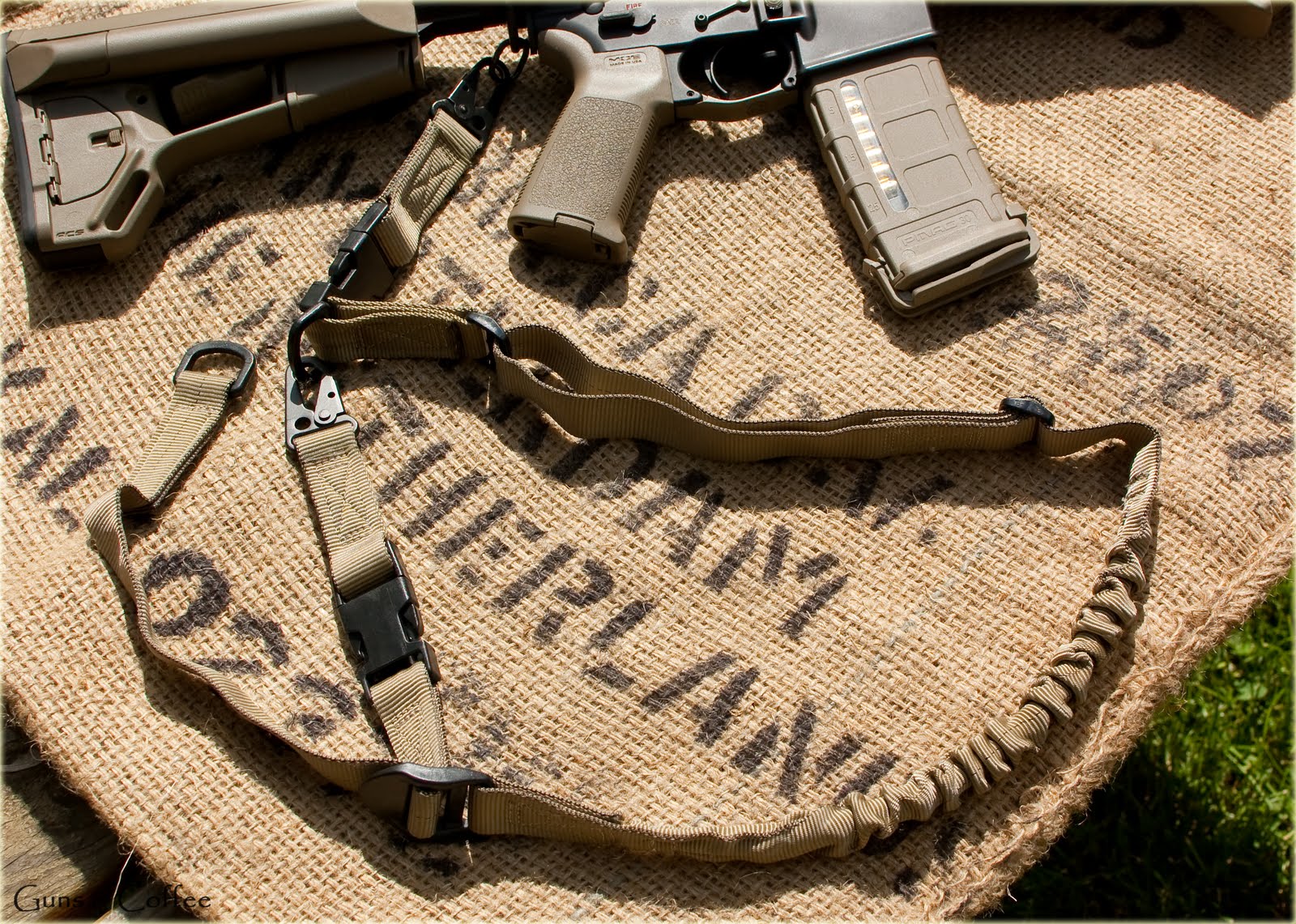
Miscellaneous Hardware Information
In the past few years, aluminum quick release buckles such as AustriAlpin’s Cobra series have found use in many tactical equipment applications. As it relates to this discussion, their 1-1.25” buckles, (current model numbers FC24B-FC33B), have seen recent implementation in several slings from manufacturers as small as Savvy Sniper to as large as Blue Force Gear. This series of buckles is particularly difficult to release compared to alternative quick release systems, especially when loaded, even only marginally, and even more so when filled with debris. It is my personal opinion that this series of buckles has no place on slings intended for practical use with long guns. They do make excellent buckles in other applications. If you genuinely believe that you need a way to efficiently detach your weapon from yourself via hardware in the sling but you do not trust traditional, plastic Side Release Buckles, I urge you to consider the use of a climbing-rated, black-oxide coated stainless steel Quick Release Snap Shackle. A small, brass version of this type of hardware is featured on the Magpul MS2 sling. It takes a little practice to become proficient at reattaching it. Snap Shackles are available through ParaGear.com and many other outdoor retailers.
S&S Precision recently released a product called the Sling Clip. If you prefer a Singlepoint but would like a level of security similar to Two-points for non weapon-intensive action, this may be a solution for you.
Using HK or MASH Hooks with a hard attachment point will eventually result in minor wear of the metal of the attachment point. I have never seen an attachment point wear all the way through, or even to a point that would cause doubt in it security. Even if only superficial, this issue can be avoided by using a soft adapter between the attachment point and the Hook. This will make it more difficult to attach to the weapon, though. 215 Gear produces an adapter for just this purpose, most accessory cord and 550 works fine as well.
I believe “Triglide” is a registered Trademark of some Illinois Tool Works subsidiary, though many companies sell comparable products marketed as Triglides. So practically, a Triglide is any friction device featuring two slots through which webbing pass created by three bars that exert friction on that webbing and prevent it from moving through the device. “Ladder Lock” or “Ladderloc” refers to similar friction devices with traditionally three or more slots for webbing, (giving the device more of a “ladder” look). It is traditionally used for adjusting the length of a strap of webbing faster than one could if using only Triglides. ITW has produced a few Ladderloc-brand friction devices with only two slots, they are weird exceptions. Triglides and Ladderlocs of various types are available at countless online retailers or your local outdoor equipment store. Most REI locations stock their own brand of each, which are perfectly respectable and compatible with the majority of the 1” wide webbing used in modern slings.
Impact Weapons Components’ 1-to-2 Point Triglide has seen widespread adoption, evaluation and praise by the crowd represented here on M4Carbine.net. It would appear to be a respectable option for someone looking to construct a convertible sling. Keep in mind that any sling you add it to must not have sewn-in hardware at its ends. Alternatively, you can cut any sewn-in hardware out, burn the sling’s end and use friction devices to secure the hardware at the ends. The IWC Triglide can be used without additional friction devices, though two extra Triglides can help move the IWC Triglide closer to your body while maintaining a static position of the connection hardware on the sling and redundantly pinning the sling’s tail to itself. At least one copy of the IWC product is currently on the market and I cannot speak even hearsay regarding its quality.
Many products currently fill the role of stowing the weapon when retained and supported by a Singlepoint by not in use. S&S Precision’s WeaponLink and 215 Gear’s Multi-Mission Weapon Retention both can help secure the weapon, each for a particular type of retention. S&S’s product is a passive retention holster, in effect, which works well when on the ground, working with your hands. 215’s product is designed for more motion-intensive applications such as aerial insertions of all types. Both are available for MOLLE platforms, S&S’s is also available with an adjustable height belt mount. Several other products fill this role however I cannot speak as to their performance.
Sling loops of any type that are 1” wide will usually accept even tubular webbing up to 1.25”, so long as the slot is high enough. Bunching up webbing in a small, circular attachment point such as Magpul’s RSA or IWC’s Snap Hooks is not an issue with respect to slings.
Most of us do not own hot knives, but a common lighter will seal 99% of webbing just fine. You can use your wet fingers to pinch the molten tip as you do with 550 and combine that with any flat, hard surface for a more professional appearance. As always, if you get molten webbing on your finger, get it off immediately. It will continue to burn you even after hardening. Keep the burnt ends as flat as possible by pinching to ensure that you can still move them through friction devices if desired.
If your particular webbing/friction device combination does not provide enough friction to make you confident in the security of the lock, you can run the loose end over the first two bars (Triglide) and through the remaining slot, under the third bar for additional friction. This will be difficult to fit through, regardless of webbing sizes. I recommend need-nose pliers.
There are more Types of webbing out there than are actually classified by Type. Most of the man-made varieties will get the job done just fine for a sling and many other applications. I highly suggest avoiding Polyester webbing of all types and sticking to Nylon-based webbing for all outdoor activities due to mildew, erosion and ultimate failure as well as less abrasion resistance in the former. As a general rule, the “softer” the face of the webbing feels, the less friction it will provide in a friction device and the more likely it will be to undo itself during use. Softer webbings do feel better on the neck but consider whether comfort is a priority for you. A good all-around webbing in my opinion is Type 7 4088 (MIL-W-4088 Type 7) webbing. It is available through ParaGear.com. For slings, I suggest avoiding 43668 and 17337. 5625 is fine if youre into that… I just dont see any reason to use anything but 4088.
But that’s just, like, my opinion, man.
.jpg)