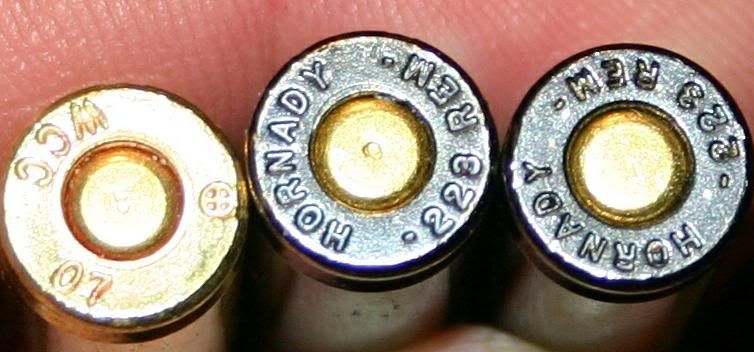
I was shooting my colt tac carbine and I noticed the unfired round left in the chamber has a tiny firing pin mark. There have been no malfunctions-- I just happened to notice while unloading. The gun has a minimum of 6000-7000 rounds through it in 2.5 years–including a vickers class, etc. The gun also has UNTOLD 1000s of rounds of 22 through it. Any clues?
Btw I tried again and it reproduced the mark on another primer/round.
The AR-15 has a free floating firing pin it does that to the primer every time it chambers a round. No worries the primers are harder on milspec ammo for that reason.
On a side note if you ever get a chance look at an SKS round after chambering it usually as a pretty good size dent in the primer.
Is it deeper than the normal little indents that one usually sees? I would probably consider doing a firing pin protrusion and headspace check. Only because of your round counts and running hard in the carbine classes.
Mt LMT and both of my BCM’s will leave a small mark on the primer after the round has been chambered. This is why once a round has been chambered I move it to the training ammo bin.
Doc Roberts did a write-up on Hornady TAP ammo and a LE Agency having a FTF on a SWAT entry (I think it was on 10-8). Fortunately it did not result in an officer injury/ death. I’ll try to locate the article.
IIRC the FTF was caused because the FP did not set off the primer when fired because it had been indented after several re-chamberings. After Doc’s article I quit rechambering rounds and just rotate in a new round.
FWIW I have not had a FTF when shooting the ammo I have removed after rechambering, but why risk it. Murphy seems to love me so I do what I can to keep the “oh shit’s” to a minimum.
FWIW the current Army stance is that a round that has been chambered 5 times should be discarded. My personal thinking is if you are using true MILSPEC ammo it probably isn’t an issue. Though I still would be checking and rotating my rounds appropriately.
"This past fall, a large SWAT team here had a failure to fire from an M4 with Hornady TAP ammo during an entry–fortunately no officers were hurt and the suspect immediately threw down his weapon when the carbine went click instead of bang. After the incident was concluded, the team went to the range and expended the rest of their carbine ammo and had one additional failure to fire. This same team had 3 Hornady TAP rounds fail to fire in training a couple of years ago. Last year, when Pat Rogers was teaching a class at a nearby agency, there were 5 failures to fire using Hornady TAP ammo. In all 10 cases, there appeared to be good primer strikes, but no rounds fired. On analysis, the ammunition had powder and checked out otherwise.
However, two problems were discovered. First, some of the primer strikes had insufficient firing pin indentations. The round from the potential OIS incident had a primer strike of only .013"—the minimum firing pin indent for ignition is .017". In addition, the primers on the other rounds were discovered to have been damaged from repeated chambering. When the same cartridge is repeatedly chambered in the AR15, the floating firing pin lightly taps the primer; with repeated taps, the primer compound gets crushed, resulting in inadequate ignition characteristics–despite what appears to be a normal firing pin impression.
Re-chambering handgun ammo can also cause problems due to bullet set back and damage to the case rim from repeated extractions.
Bottom Line: Once a round has been chambered, DO NOT RE-CHAMBER IT AGAIN for duty use–relegate it to training only. This is CRITICAL!!!"
Good point. As far as I know, most of the HK416s have a captive spring around the firing pin. The earliest ones might not. Mine does, and it is a 2005 model. I believe they added the captive spring around the firing pin pretty early on.
I did a test just now where I chambered 3 rounds in different rifles 5 times in each gun. You can see a tiny dimple from the firing pin.
The first is a round of Black Hills factory that I chambered 5 times in a Noveske N4 Basic. You can see a tiny dimple from the firing pin.
The second is a round of TAP FPD that I chambered 5 times in the same Noveske N4 Basic. Also, there is a tiny dimple. It looks a tad bigger than the dimple on the Black Hills round. It looks like a bigger difference than it is between the round of Black Hills and the TAP round due to the lighting. But it really is just a tad more of an indentation on the TAP load.
The third is a round of TAP FPD that I chambered 5 times in an HK416 upper mounted on a Colt 6920 lower. The last one shows no marks on the primer since the 416 has a captive spring around the firing pin.
You cannot get a dimpled primer from chambering a round in a properly functioning HK416. The HK416 (and my HK MR223) has a firing pin safety.
From the MR223 operator’s manual:
“Pulling the trigger releases the cocked hammer. Just before the hammer strikes the firing pin, the hammer releases the firing pin safety. The firing pin strikes the cartridge primer.”
Sorry I needed to clarify. The rounds pictured are the ones that had the FTF after being rechambered several times. It was just to illustrate that they had a good primer strike but still did not fire.
I’ve never noticed in my AK but I do know that it has a free floated firing pin. Im assuming the same thing happens with them too right? BTW Im outa ammo for now or i’d test it:p
I’ve never seen this with my AK only AR’s. I’ve never used brass ammo in an AK though, I would guess the russian primers are much harder than western commercial primers??
Interesting stuff here. To be honest, I have never examined the primer of a round after having chambered and then extracted it, something we do every warrant service. I’ll now pocket that round and throw it in the training box afterwards. I’ll also cut and paste this string and share it with the full-time staff and the other part-time instructors. Thank you.
Also, can someone post picks of the HK firing pin installation? I am intrigued.