I posted this in “Terminal Ballistics” but nobody seemed interested…perhaps this is a better forum to post it in…
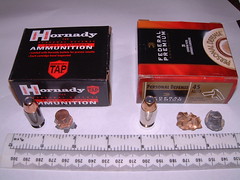
I did a “test” a while back where I shot two ammo brands into milk jugs filled with water at 7 yards. Then I recovered the bullets to see the deformity. Nothing scientific, just kind of curious. These are .45 self defense loads, one a Hornady TAP and the other Federal “Personal Defense.”
I found the result quite interesting, but I’m not sure what to make of it. The TAP bullet peeled back but generally retained its weight. The Federal bullet totally peeled back and the jacket separated.
So the question I have is, which is better? Is it the TAP because it retains its mass and delivers more power? Or is it the Federal because it opens up more and causes a bigger cavity and perhaps more damage?
FBI recommends a minimum of 12" of penetration into 10% ballistic gel. and 20" maximum penetration. Remember every human is different in build and wearing different clothing. The variables are huge. For example; skinny, weak guy in a T shirt vs. heavy set, muscular guy in a leather coat. IMHO penetration is more important than expansion. Most self defense ammo is designed to prevent over penetration and risk to bystanders. I find it hard to believe a bullet traveling at 1100 Fps @ the muzzle striking a target @ 15 to 20’ distance, deforming and penetrating through a attacker having enough energy to seriously wound or kill any one. I think most of this is legal precaution. Expansion is a good thing as long as it doesn’t impede the bullets ability to penetrate vital organs. Rule of thumb is the larger diameter bullet you use, the less dependent you are on expansion. 45 ACP, even with ball ammo, has a proven record. I’m a fan of Dr. Fackler and Peter Kokalis, so this is how I came about my opinion. Also, don’t forget shot placement is everything.
I could NEVER get those damned XTP bullets to expand at all in bare water jug research. Those things never struck me as being any better than ball ammo.
If you don’t like the jacket separation, go with the Speer Gold Dots. Those things expand great, and don’t shed the jacket from what I’ve found.
I used to carry CorBons, but they shed the jacket EVERY TIME i shot them, so I switched to gold dot. Not that jacket shed was the end of the world, but I preferred a bullet that stayed together.
Yeah. And the jacket is not that heavy. My opinions are not based in science. But when my .40 corbons would shed the jacket, you were left with what was like a 9mm bullet that continued on thru the target.
Which is better you are asking? Who really knows but one thing is for sure, if you took 2 identical twins and shot them both in the chest at normal distance, I would be willing to bet you couldn’t tell a difference between the two. I’d bet they would both hit the ground with identical wounds DOA.
Cool test by the way, I always love the “home tests” people do on here because it makes it seen more realistic than the lab results we get from companies or professionals (not saying you are not a professional). Not saying labs results are bad they just get boring compaired to “hey I shot this and this happened” stuff.
Either will do just fine. The reason I personally use these types of ammo are not for more killing power, I do it for less penetration and chance of a bullet going into an innocent bystander. Even though shooting in self defense might be justified, you are still liable for the bullet if it hits your nieghbor, or god forbid, your kids.
Testing expanding bullets in water gives the wrong results because water is less dense and has less tensile strength than flesh. Bullets that fail to open in water may work perfectly in tissue. Also remember that various species have different tissue densities and skin strength.
I have done a ton of this type of testing, I used to use one gallon zip locks staged inline within a home built frame. It gave an expansion test along with a course penetration test and this is a partial reason I too switched to +P Gold Dots.
I just saw an ad for a new Hornaday load, FTX I belive. The hollow cavity is plugged with a flexible material. The ad states that clothing and other material can not plug the cavity and prevent expansion and that the flexible material exerts even pressure on the bullet to give (claimed) 100% expansion regardless of the clothing encountered. This looks like it might be promising, anyone else seen/used it yet?
What’s the difference between the Federal Personal Defense HP and the Federal Hydra-Shok HP?
I have some 180gr Hydra-Shok Hollow Points from about 10 years ago and was wondering if it’s the same as they make today.
I also have some Federal 180gr Hollow Points from about 15 years ago (Red Box). They have red sealant on the primers. I was wondering if they were the same thing as the current line of Federal Personal Defense Hollow Points?
But then one side would complain that the tests weren’t controlled enough, because different people have different internal structures, body shapes, etc.
The other side would complain that the tests weren’t random enough, because in real life shootings you cannot control for things like distance, angles, etc.
That’s why having a homogenous medium and using standardized protocols gives scientifically repeatable results. I’m not saying that tells us the whole story (some believe it does, personally I don’t) but it certainly beats random guesses and homespun experiments.
“Service caliber handgun bullets generally only disrupt tissue by directly contacting and crushing it. If service caliber handgun bullets fragment, wound severity is generally decreased, as the amount of tissue crushed is reduced. For service caliber handguns, it is ideal if the bullets stay intact and retain all their weight.”
Water is a reasonably good test medium to assess bullet upset; many crime labs use water recovery tanks for that purpose. Be aware that water generally reveals the MAXIMUM upset which can occur to a projectile in soft tissue—your actual upset in living tissue may be somewhat LESS. Remember that the bullets will penetrate in the neighborhood of 1.6 to 2 times farther in water than tissue, so make sure your recovery tank is has sufficient length to capture the bullets you intend to shoot.
FWIW, the Hornady TAP, Federal “Personal Defense”, as well as Hydra-Shok are all older bullet designs that do not perform particularly well, as they do not offer robust expansion–often times plugging-up and failing to expand–and can be prone to core-jacket separations.
When I did this “test” I was mainly just fooling around and since I had empty milk jugs available I figured what the heck. I didn’t figure they would be great analogs, but would be better than shooting into sand (which I also had readily available). Maybe the next thing to do would be to put a couple of layers of clothing on top of a milk jug, or better yet maybe some jello in a gallon zip lock, and see what happens. Again, not scientific, but interesting.
Really, I was just surprised to see the big difference in what the two bullets did, and I wasn’t sure which one was the more desirable outcome.
I now have Cor-Bon Powerballs in my carry gun to try to avoid the issue that I’ve read about, and someone pointed out, that the cavity in a .45 hollow point can get jammed up with clothing and not expand. Haven’t tested this theory out yet though. Maybe the clothing over milk jug test isn’t such a bad idea after all…
BTW, I also recorded myself shooting the Federal and TAP at night b/c the TAP said it was low flash. I did not notice from my angle (shooting) less muzzle flash, nor did it look like lower flash on my tape when I played it back. Of course, I was using a regular video camera not a high speed camera so maybe there would be some difference in the two if I had sophisticated equipment. But the point is, it advertised low muzzle flash and I didn’t see any difference.