Newbie here and sry if this is a stupid question.
Can you co-wittness with a Aimpoint Comp C3 sight??? And if so what would I need to get to do this? What mount???
Thanks Casey.
Newbie here and sry if this is a stupid question.
Can you co-wittness with a Aimpoint Comp C3 sight??? And if so what would I need to get to do this? What mount???
Thanks Casey.
I use this: (Larue LT-129 Cantilever mount)
It allows for a 1/3 co-witness. Good luck!!
Thanks.
Any other opinions? The 4 MOA dot or the 2 MOA dot?
And sry for not knowing. But what is 1/3 co-witness?
Thanks Casey.
I looked thru a co-witness set up, then thru a 1/3 lower set up, such as the LaRue mount mentioned above. I think you’ll like the 1/3 better. You get a better field of view, with less clutter when looking thru the aimpoint.
Not with the mount that comes with it. You can if you buy a better mount.
We offer member pricing on Aimpoints and have the C3 in stock. Drop us a line if interested.
C4
Get 2MOA. Lower 1/3 means that your irons will appear in the lower 1/3 of the Aimpoint window.
C4
Ok thanks
Go to www.downrange.tv/show2 “Aimpoint: The Red Dot Solution” to watch/learn more about Aimpoint sights and how to use them.
S/F
Yep I did.
Thanks
It looks something like this:
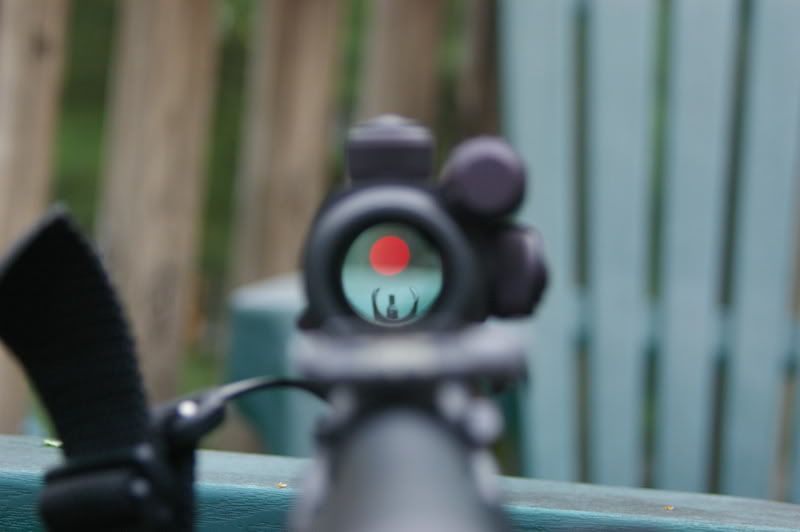
The sights are in the lower 1/3 of the optic.
Bought a CompC3 off a guy for $200.00. Used but very very little. No scratches or anything. Anyway thatnks guys for the help and all. Took it out today and sighted her at 50 yards. Didnt do too bad to me for someone who has never shot using one before. Using a stock trigger too. Got a new trigger coming. Going out again tomorrow.
Like I said thanks for the help fellas. Casey.


I think I understand how this 1/3 co-witness works with a sight but I still have not physically seen how this works. Will somebody explain the 1/3 and 100% co-witness, or even draw a small diagram?
An absolute co-witness means that when you look through your iron sights and optic your front sight post appears dead center in your optic with the red dot on the tip.
A lower third (sometimes called a SOCOM) co-witness does the same as above except in the lower third of the optic. You can slightly raise your head position and just view the dot.
To add just a bit of clarity (I hope).
If a “normal” height mount gives an absolute co-witness then you raise the optic just a smidgen to obtain a “1/3” co-witness.
So on absolute will the red dot be literally on the tip or resting on the tip?
and if i raise my head won’t the dot go further down the front sight?
An absolute means the sights align with the dot in the dead center of the optic. A lower third co-witness means the sights align with the dot in the lower third of the optic. The red dot will always sit on the tip of your front sight if you are looking through your rear. Remember that optics like the Aimpoint are parallax free, so as long as you can see the dot anywhere in the optic you are going to make your hits.

Is this correct?
IF it is then is does the optic sit higher since the dot would be in the lower 1/3 of the optic?
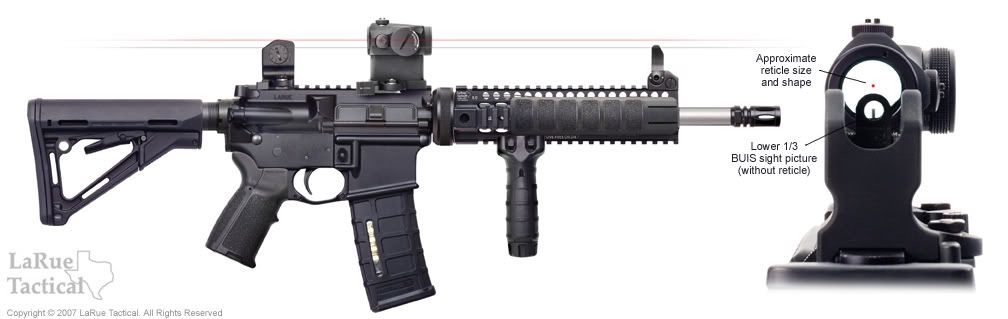
think i got it.
in what circumstances would one be better over the other. absolute vs 1/3
and last questions: Does that mean a 1/3 co witness optic will actually sit higher than absolute? Will a added spacer make your optic 1/3 OR is it for going from 1/3 to absolute?
A lot of it is personal preference. I would say that 1/3 co-witness has all the advantages but none of the drawbacks. Your normal sight picture with the red dot will be less cluttered. On the other hand, I find it slightly more cluttered using the irons through the 1/3 co-witnessed optic, but not so much as to undo the value of having the red-dot more visible to me.
and last questions: Does that mean a 1/3 co witness optic will actually sit higher than absolute? Will a added spacer make your optic 1/3 OR is it for going from 1/3 to absolute?
Yes, the 1/3 co-witnessed optic will have to sit slightly higher. Some mounting systems do this by just being designed taller (Larue’s mounts for example). Others, like the ARMS mount, use a spacer added into the body of the mount to change the height.