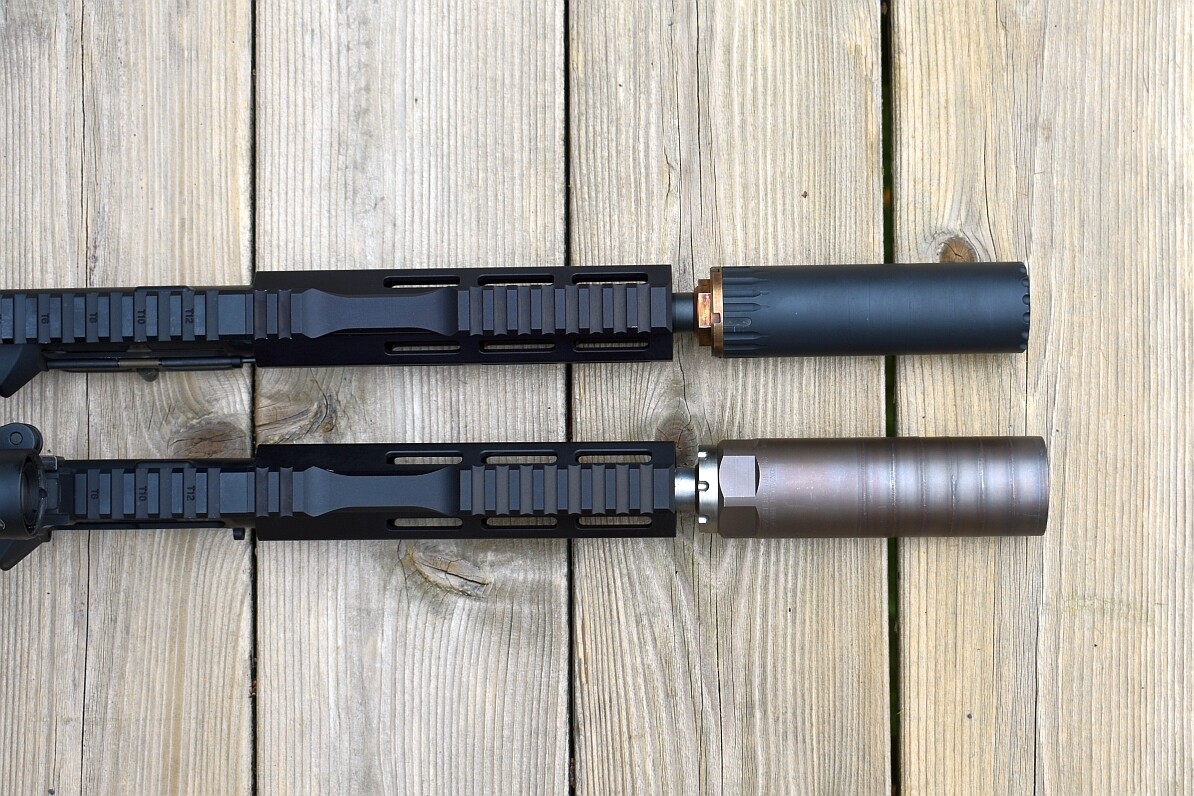
Since we last discussed this, I’ve investigated this myself with the help of some friends of both genders. I had Rex make me two more custom cans, and aquired a couple more off-the shelf cans.
Cans tested include: CGS MoD 9 3 lug, Omega 45k 3 lug, Omega 45k Plan A, Rex .458 MG7k Plan A XL, Rex 3 baffle .358 Plan A L, Rex .375 7 baffle Plan A L.
Hosts include: 7.5” and 8.5” 3 lug and Griffin Taper mount, 12”, 12.5”, and 13” with Griffin Taper mount. Bolts used were 17.1 oz bolt, achieved with tungsten and brass weights and a generic 14.6 oz bolt. Buffers used were 5.6 oz buffer, and 12.4 oz (holy shit lol) buffer. Don’t expect all of those combos to be reliable….
We first compared the MoD 9 to the O45k in trilug configuration on the short barrels. Notably, the internal trilug adapters for each impaired their sound performance, and made them gassier than expected. The O45k was somehow both loud and gassy, and the MoD9 was even gassier than normal, and not as quiet as normal. It was quieter to bystanders and about the same as the O45k to the shooter. I then switched the mount to Griffin Taper/Plan A on the O45k using a 9mm EZ-Brake mount which improved both performance and backpressure. It now lives on that host, tucked inside the handguard. This gun is just a novelty that comes out occasionally, and I’m happy with the performance.
Next up, we compared the 3 rex cans. The 3 baffle 9mm MGx is 4.25” by itself, and 5” with adapter. This is the newest version that increased baffle spacing from .5” to .625”. The .45 MG7 control is the older 6 baffle version with .5” spacing and a larger blast chamber, and I’m using it with a longer adapter than the other two. It is 5.6” by itself and 6.5” with adapter. The 7 baffle .375 MGx is 6.7” bare and 7.4” with adapter. It is also the newer version with wider baffle spacing and a smaller blast chamber. These are all 1.7” diameter rifle cans.
These 3 were used on the moderate-length 12”-13” SBRs using a Griffin 9mm Hammer Comp, legacy gen. This is the setup that I actually shoot all the time as a training analog.
From the bystander perspective, all thought that the 6.5” .458 sounded slightly better than the 5” .358, but was almost too close to tell. From the shooter’s perspective, they sound about the same, but the .358 is slightly gassier. From the bystander’s perspective, the 7.4” .375 was noticeably quieter than the other two. It was a bigger difference than between the first two, but nothing crazy, as the first two are surprisingly effective, and the long one is in the neighborhood of diminishing returns. From the shooter’s perspective, the 7.4” .375 has more backpressure, and the ejection port pop is much more noticeable. What isn’t clear is whether the port pop is actually louder, or if it’s just perceived that way because the muzzle report is quieter (if you shoot steel back to back suppressed and unsuppressed, you’ll know what I mean about perception).
Dicking around with buffers and bolts did not seem to have any effect, from 22.7oz total mass to 29.5oz total mass. This is why I wonder if the port pop was really any louder, or if it was just perception. No effect on sound, that is. Tinkering did have an effect on reliability, and with a ~12.5” barrel and a silencer, I think 20-24oz is probably where you want to be, and maybe 18-23oz unsuppressed. USPSA and IDPA PCC loads may want to go lighter yet, of course.
The footlong host is zeroed with the long .375 can for pest control reasons, since it is clearly quieter. But it is mostly shot with the 6.5” .458 can because it’s more pleasant to me, the shooter. Some of that is probably due to the much larger total blast chamber volume. The .358 can is kept around for when I want to cut an inch and a half off the gun, and the Hammer Comp mount exists for match purposes and to make the .458 can more effective at signature reduction. There is surprisingly little zero shift between the 4 configurations; not enough to matter at ranges relevant to 9mm.
We’ve also screwed around with some other hosts and cans, such as the Mojave 9, Griffin .45 Resistance and Revolution, Rex .358 5 baffle new style MG7, Ruger PCC, Scorpion, KP9, and MPX, with similar results, but with more narrow comparisons. Except the Mojave…it is both very quiet AND very low backpressure. What isn’t clear is whether it will stay that way, or if those tiny passages will clog. It’s also 2-4 times the cost of the others. I’m skeptical, and we haven’t shot it back to back on the same hosts, either.
TLDR; quieter cans are quieter, louder cans are louder, and backpressure is a variable somewhat independent of sound, though there is some correlation.