…
…
Trident, Good work on an interesting topic. FWIW, Years ago I went through law enforcement basic sniper school and showed up with an AR., the only non bolt, non 7.62 in the class. The other students all chuckled. I had no problems on the quals, and we shot out to 600(not for quals). By the end of the class all of the other students weren’t laughing anymore. I used a Krieger 20" tube JP trigger, Leupold, and BH 68 grainers. After the class I started using a few 18"s and finally settled on 16" as my standard for an 5.56 AR. For me other than the idea of having multiple carbines, which I do the 16" is all the length I need. I’m currently playing with a Crusader barrel and hope to have some data on that out to 300 shortly. I’m thinking about pulling the barrel as I’m not getting groups I think I shoud, starting from zero again.
As much as I apprreciate your work I wonder how the 14.5’s and 12.5’s would fare? I’ve found in my own shooting that the 14.5 seems very close to 400 and then tends to open up and am hoping the 12.5 will be good to 250-300. I’ve never used Rock’s for AR’s. How do they compare to Noveske or Krieger?
Trident, great thread. Put together very well with a lot of thought and research/work as usual. I’m always watching your threads and amazed at your dedication. I’d like this thread to continue with different loads and distances comparing both rifles. Great shooting and rifles as usual.
So, you’re reducing the definitions to distinctions between barrel lengths and minor difference in optics?
I ask because I’ve always been confused by these definitions and how they get thrown about, and how they relate to other common terms like “sniper rifle” or “DMR”, etc. and I think that it appears that some people get hijacked by their perception of the definitions rather than application for their purposes. Some people (clearly not you since your rifles deviate pretty heavily from what I understand are the issued versions) get consumed by making replicas rather than tools.
Maybe a chart contrasting the two would help. :sarcastic:
For those of us not as steeped in this arena the distinctions become confusing.
Relative to the differences in optics, do you think that some shooters may do better with one optic/reticule type while others might do better with the other?
…
Nice post Trident…I really like the “Ghey” Dirty Bird targets you used 
Trident,
I appreciate what you’re trying to do here and those are beautiful rifles, however I’d like to comment on your implementation of the scientific method. For brevity, I won’t get too geeky here and won’t touch on sample size or proper methods for the design of experiments. Given a sample size of one per each configuration indeed one would want all control variables to be as similar as possible. You’ve stated as much, but what you’re comparing is the effect of two different barrel lengths with different muzzle devices and slightly different optics using “cherry” picked results.
The controls variables that are different are the optics, muzzle devices, and barrels. I don’t think the more compact NF would have any appreciable effect on results (save a slightly narrower FOV and less light transmission), particularly at 100y. We know that barrel characteristics can have an effect on precision, but different muzzle devices can have an effect too, though it may be minor.
I’d recommend making your comparison rifles as similar as possible (if that’s your intent) by losing the muzzle devices or using the same MDs and comparing all groups or random samples of your groups.
Just some suggestions, again, I think threads like this can be informative.
I think there is no argument over “Recce” vs “SPR” except barrel length.
Many tactical precision shooters are moving to shorter barrels.
The only difference at that point is muzzle velocity and the resulting ballistics. His topic is about two different concepts of rifles, not comparing two barrel lengths on the same rifle otherwise.
…
Sweet thread! Lots of great info. I WANT TAP T2 SO BAD!!!:mad:
Battle for light precision supremacy: The Recce Rifle Vs. The SPR
Summary: Both rifle concepts can be plenty good in the accuracy department.
Conclusion: Both rifle concepts can be plenty good in the accuracy department.
Winner: Both?
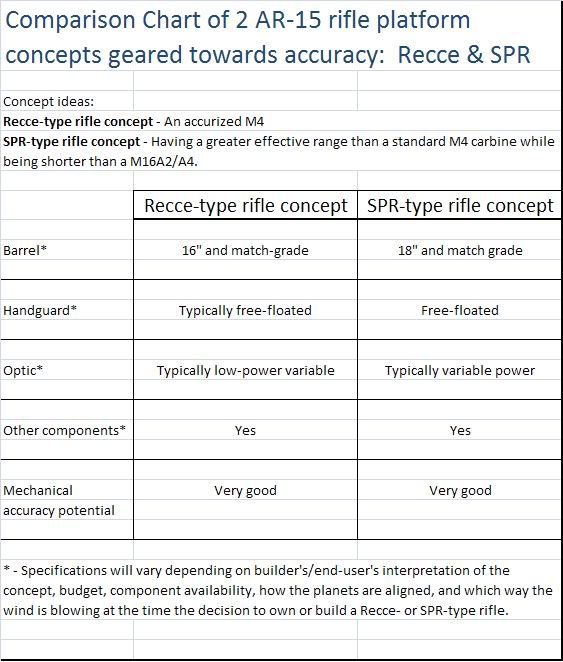
That’s the best I could do in a hurry with my tongue firmly planted in my cheek.
In all seriousness, I do appreciate your detailed insight, Trident. I find the Recce and SPR concepts quite interesting, and I look forward to reading more about your comparative findings between your two rifles. And those are mighty fine rifles.
Hi hikeeba!
You forgot carbine (Recce) vs. rifle (SPR) length gas systems.
-
Trident’s comments on control variables is more apropos an experimental comparison rather than a conceptual comparison, particularly given point #2 below. At any rate, my primary issue with the results is the cherry picking among the groups.
-
With regard to the comparing concepts, what’s the real difference other than barrel length given this modern interpretation of these two configurations? That is, I would expect those concepts to resemble the traditional configurations if that’s the intent (admittedly this is difficult given all of the variations of SPRs and Reeces). For example, doesn’t the SPR employ a OPS Inc brake, Douglas barrel, KAC 2-stage trigger, etc?
I’m not criticizing what Trident is trying to do, just making some suggestions.
Howdy to you!
I was trying to make a chart that outlined the two different general concepts as simply as possible. I didn’t want to get all knit-picky about the ‘finer’ details. The gas systems can fall under ‘Other components.’
Not a concern of Trident’s or mine but…does the 18" barrelled SPR offer any advantage in terms of killing/wounding potential (lack of better words) at longer distances? Would that lead the military to choose the longer bbl for extended shots at range or is that where another caliber comes into play (.308)?
If simplifying the difference between the Recce and SPR is as simple as 2" of barrel, and comparing apples to apples, the biggest two differences are muzzle velocity and weight - which are not all that different practically speaking.
Another part of the equation will be if the rifle is going to be ran suppressed - weight and length of the suppressor in question is likely to change the handling characteristics more than the barrel itself is going to.
What I’m looking at right now is adding a Recce unit to my existing Mk12/DMR upper, but trying to make this Recce unit a do-all rifle by installing a 1-8x SB optic, Scout Light, and throwing that upper on a Noveske FFL with UBR/GSSA. I would swap between an OPS 14th and M4S, the latter keeping the OAL of the recce still shorter than a Mk12, and providing some sound reduction.
Since so little shooting on the civilian end involves anything beyond 600m, I don’t see how the Recce isn’t the better choice against paper, and I’d still make an argument that same net weight against same net weight, the shorter lighter Recce affords for better, larger glass up top.
As great as the Mk12 was among military weaponry because it had innovative parts like 2-Stage trigger, free floated handguard, OPS suppressoor; that doesn’t mean it’s the superior option among groups not restricted by NSN’s or type classification, so this is why the Mk12 may be common, but never superseded the Recce.
…
My Recce is a middy not a carbine gas system;)