AAR Vickers Tactical / LMS Defense 4 day Pistol - Rifle Course

In October 2007, LMS Defense brought Larry Vickers to San Jose for four days of tactical pistol and carbine training. Larry’s reputation for solid, relevant training ensured a strong turnout, with 17 students in the class.

The class was a mix of novice shooters, experienced weapon handlers, and armed professionals. The prevailing attitude of the class was very positive and open-minded. I noticed the armed professionals on several occasions offering good, quiet advice to the novice shooters; there were no “cool guy” cliques in this class.

Larry Vickers, as expected, was a pro from the start. He was prepared to teach from the get-go, and was able to tailor the course to fit the exact mix of students in the course. I was impressed watching Larry customize the course on the fly as the needs of the class members dictated. I have always been frustrated with trainers who teach a fixed curriculum regardless of student needs; Larry was a pro at quickly identifying ability levels and running drills appropriate to the situation.

Day one began with the root of pistol shooting, trigger control. Larry ran several drills designed to teach the students how to train themselves after the class. We then moved onto sight picture, weapons manipulation, and trigger reset. After conducting a milestone drill (a walk back competition) to test skills taught to this point, we moved onto ready positions and turns. We ended the day with another competition and debrief. I got a lot out of the fundamentals hammered on day one.

Day two began with a skills re-set and review. We then worked on a sane, well thought out set of malfunction drills. Again, students were given the tools and tips to take these drills and incorporate them into their personal training time. I am a strong believer that we do not pay to go to training in order to be trained, but to learn how to train ourselves. After another competition and milestone drill, we moved on to shooting the pistol on the move for the remainder of the day. I found Larry’s treatment of this subject logical, simple and complete.

The Carbine course started on day 3 with everyone’s favorite, zeroing. Just a note on this subject: when you know you will be taking a rifle or carbine course, please go to the range and zero your weapon system. Please.

Once this painful process was complete, Larry moved us into carbine fundamentals and marksmanship. I liked Larry’s emphasis on distance shooting under time. We worked with the carbine out to 100 meters, off both shoulders, learning to take advantage of the distance the system’s accuracy allowed us. The day was punctuated by competitions and milestone drills which tested our ability to effectively manage the weapon under mild stress.

At the end of day 3, we had the pleasure of a presentation from Mr. Freddie Blish of Aimpoint. Mr. Blish came to us fresh from his appearance on the cover of this month’s SWAT magazine, and was gracious enough to give a concise presentation and answer cogent questions about the Aimpoint family of combat optics. Several students also had the opportunity to use some of Aimpoint’s newest products in class (the Micro Aimpoint and the Comp M4) thanks to Mr. Blish.

Freddie also held his own in the course…….

Day 4 began with a detailed discussion and show and tell regarding the HK 416 5.56mm carbine. As you already know, Larry was deeply involved in the development of the system; and getting this lecture from him was well worth everyone’s time. Many internet rumors and other assorted BS stories were dispelled.

When we hit the range for day 4, we were held to account for everything we learned the day before through a skill set drill. We then moved onto malfunction drills (including the “prom night” maneuver) and transitions. I was very happy to see a detailed explanation of the appropriate times for each (i.e. Inside 25 meters transition to your pistol and finish the fight; and outside 25 yards fix the carbine). I noted Larry took care to encourage the proper response based on distance to the target, and did not set the students up for later failure by creating artificial circumstances on the range (e.g. teaching all malfunction drills outside 25 meters).
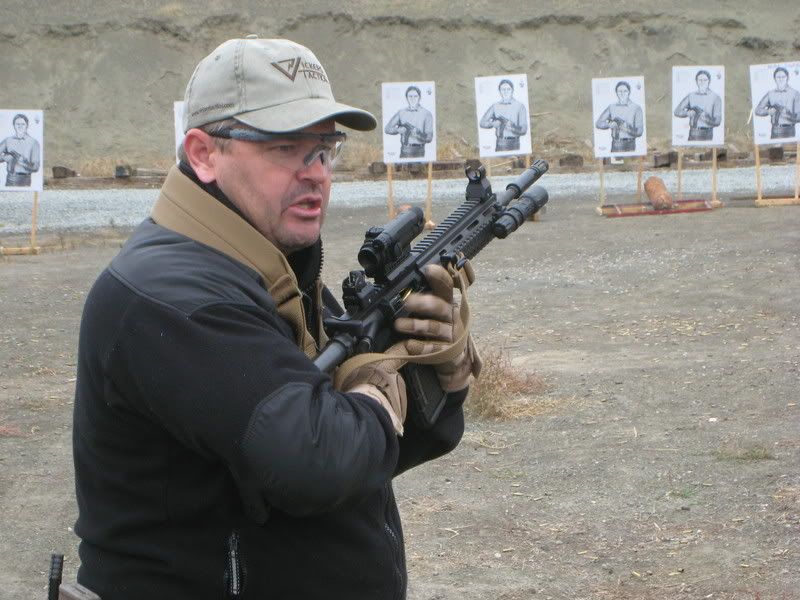
After another competition and lunch, we began moving with the carbine. Several simple drills were used to good effect, and much expanding of horizons took place with some of the newer shooters. The day ended with a difficult but realistic qualification drill which brought together all of the skills we had been working on for 4 full days.

In conclusion, I found Larry Vickers to be a highly relevant and capable instructor. His real-world experience and many years of teaching Tier 1 units to fight are an asset too valuable to pass up if you ever have an opportunity to train with him. I found the combination of repition, competitions and the shot timer were very effective as a teaching methodology; and observed their use to great effect throughout the course.

We at LMS Defense will be bringing Larry out for several more courses in 2008, including his 1911 builder’s course in Reno, NV; and another 4 day pistol-carbine package in Seattle, WA. Check our website (www.lmsdefense.com) or Larry’s (www.vickerstactical.com) for dates to be announced soon.

Those walkback drills are a bastard…:mad:

:smiley:

I had an excellent time in this class and learned much. Larry’s treatment of trigger control is different than any other explanation of the “Why?” it is so important. His three dummy and ball drills are absolutely fantastic.

Larry’s emphasis on time and accuracy drills, along with the walkbacks, reinforce the skills he teaches you. I must say that I shot like the biggest tool in the class; “El Snatcho” is my constant companion.

One thing that doesn’t come through in the pictures is Larry’s sense of humor: I think we are going to collaborate on a Pat Aherne Signature Model Short-Bus Tactical Single Point Sling, complete with green zip-ties and possibly some duct tape! Seriously, after this class, I called up Grant and ordered the Vickers Two Point Sling without the Fas-tex buckles. I tossed my single point in the trash.

Larry is definitely worth spending your training dollars on and I would take the exact same class over again.

Thanks to Chappy and LMS Defense for hosting LAV, it found it extremely worthwhile.

Good stuff.

Whats a walk back drill?

[ Seriously, after this class, I called up Grant and ordered the Vickers Two Point Sling without the Fas-tex buckles. I tossed my single point in the trash.

Larry is definitely worth spending your training dollars on and I would take the exact same class over again.

Why, without the fastex buckles? What was Mr. Vickers opinion on the set up. I see how he has his set up, simple and rugged…

I appreciate your answer.
Jack

Thanx to John and LMS for hosting me and thanx to Cali class for a good group of guys - everytime I go to Cali the class is great; I am sure it is because they realize how valuable our 2nd admendment rights are in their embattled state

Thanx to Freddie Blish stopping by on behalf of Aimpoint - as always with the latest Aimpoint goodies - and shooting well I might add

A keen eye will spot the first prototype Vickers padded sling on my 416 - Ashley of BFG and I are in close communication on it; we are going to narrow the pad for the carbine version but other than that I think it is right on the money; stand by for more info

Looking forward to more classes with the LMS crew

Cheers

Larry Vickers

www.vickerstactical.com

Cool… looking forward to it the sling.

Looks like it was a terrific class.

Y-

Looks like a great class, thanks for the AAR.

Rugger, a walk back is where you have the guys take a shot from the low ready at a target. Those who make their hits get to walk back, increasing the distance to the target, and then shoot again. Repeat the walk back, increasing distance.

This continues until the last guy who was hitting his target misses.

Bragging rights are then awarded. :cool:

And sometimes slings.

:wink:

I love the walkback drill. It highlights every fundamental of marksmanship and builds confidence!

I have had Fas-tex buckles come loose and drop my loaded rifle, muzzle first, on the ground. For Mr. Vicker’s class, I remedied this with bright green zip-ties around the buckles to prevent them from opening. It’s almost Christmas, don’t you know?

Grant carries a version of the Vickers Two-point with sewn-in QD swivels and no Fas-tex. Fas-tex are good for being able to pop out of the sling and ditch your rifle quickly, but the main function of the sling is to keep the weapon attached to my body, and the Fas-tex just wasn’t cutting it.

You’d have to ask LAV what his opinion is on how he sets up his sling. His opinion of how I had my single-point sling set-up was rather colorful and thoroughly entertaining. I enjoyed every minute of it.

The more I think about this class, the more I realize how much I just didn’t know about trigger control and how important it is. Now, if you looked at my training resume, it’s pretty impressive. However, in all those hours of schooling, no one explained, at least in a way I could understand, why it was so important and how to perfect the trigger press.

Keep in mind, I am not a good shooter and consider myself rather average and minimally competent. That’s why I train. This class helped me identify my deficiencies and will, hopefully, allow me to improve my performance in the future.

I know there are some folks out there reading this who haven’t been to training classes and may be intimidated by shooting poorly in front of others, or not having the coolest gear. Let me reassure you, by not taking classes from good instructors, and I place LAV near the top of anyone’s heap, you are only hurting yourself and wasting money blasting ammo.

Plus, if you don’t have the optics and newest doo-dads on your rifle, you can see what works on other people’s gear and perhaps even try it out. On the flip side, if you have that adjustable gas block, match trigger and Eotech, you can run them hard and see when, not if, they fail.

Fred Blish was handing out loaner Aimpoints to folks whose Eotechs crapped out.

The technical information that Larry passed along was worth the price of admission. Prior to this class, there had been a push by my regional SWAT team to acquire suppressors. After seeing the HK 416 and the LWRC broken down, I understand the issues with suppressors and direct impingement rifles. I came back and used the information to get $5K of new headsets instead of the suppressors because I was able to explain to my captain why suppressors are not a simple twist on solution and the issues we would face if we bought them. We may buy them in the future, but we will also buy HK 416 rifles for them to mount on.

If you are a regular guy, firearms instructor, SWAT guy, or massage parlor operator: take a class with LAV when he is available. Take a class with a local, good training provider, like LMS Defense, in the meantime.

Larry helped me set up my sling on my SLR-106FR. He said that he does not like to use the fas-tex connectors but that they are an option. He told me that with no gear on (basically just your shirt) you should be able to shoulder and use the rifle normally with the sling at its tightest. Then you can let the sling out as necessary to accomodate chest carriers, armor, weak shoulder transitions, etc.

Fred Blish was handing out loaner Aimpoints to folks whose Eotechs crapped out.

Freddie Blish is a fine American representing a great product line. I’ve had Eotechs, I used them in classes and so on… I stongly prefer Aimponts.

Y-

I like the Eotech reticle best of all, however, I might have to shoot someone and I can’t be sure that it will work when I need it to. The Aimpoint works and is cop-proof.

Chappy just about covered it all. That was the BEST class I have veer attended.

More so for the information on trigger control and “El Snatcho!” than anything else.

My shooting skills have definitely improved. LAV is a true professional. I look forward tomy next class with him and LMS. 

Pat, good to hear from you!

Mace

Shooting with someone of Mr. Vickers’ vast expertise is always an enlightening experience. It is easy to get into a training rut and get complacent with our shooting. No matter what level a shooter has progressed to, shooting fundamentally revolves around sight alignment and trigger control. Larry’s emphasis on accuracy, coupled with time pressure rapidly illuminates any technique flaws and trouble areas a shooter might have developed. The “ball and dummy”, Siebel (3 x 6 shots), “humbler” (7 x 10 shots), box (12 shots pistol/24 shots rifle), walk-back (to 80 yards w/pistol and 200 w/rifle) drills are all key for reinforcing fundamentals. Larry teaches very good reloading and malfunction routines that can be used rapidly day or night. The 300-350 shots taken each day may seem low, but not when each shot must be precisely placed, while both static and on the move.

This is one of the few training sessions I have attended that had civilians, as well as LE and military personnel. As such, there was a greater mix of equipment and resulting issues than with unit training. A few things are worth noting. For tactical holsters, the Safariland 6004 modified to sit higher on the leg and use one strap is the way to go. For those stuck wearing armor in vehicles or dismounted on long patrols, a vest mounted holster is a good alternative. There are a lot of good sights currently available—Novak, Heinie, Warren, 10-8, so as one shooter in the class discovered, why compromise yourself with something that is less than optimal, like the XS pistol sights? Shooters using pistols with a consistent short trigger pulls (1911, Glock) generally found it easier than folks with traditional DA/SA (ala M9) or long trigger pulls like the DAK or LEM. In addition to the ubiquitous problems of “el snatcho” and sight alignment, many folks found they really needed to improve their reloads and practice shooting on the move.

Over the past 2 decades I’ve used many 1911’s, both issued and purchased—I shoot the 1911 better than any other pistol I’ve used. When properly customized, a 1911 is as reliable, durable, and shootable as any pistol ever created. Yet 1911’s are probably not the first pistol I would recommend for most people in this era, as 1911’s are only viable with significant inputs of time and money on the part of the shooter. I’ve had over a dozen 1911’s customized by various “big name” pistol smiths, but I have gotten rid of a third of them, because they did not prove 100% reliable and another third had to have additional expert pistolsmith attention by Chuck Rogers in order to finally run correctly. In addition, 1911 magazines are problematic, as several users found out in this class–save 10 round mags for training. Far too many of the 1911’s I’ve seen people shooting are truly not reliable enough for serious use. If a pistol, including 1911’s, cannot fire 1000 consecutive duty rounds without a malfunction, it is not fit for duty/carry.

For a simple out of the box pistol it is hard to beat a stock 9 mm Glock—change the sights, perhaps add an excellent Vickers/TD mag-catch, and if you desire get the grips stippled, but DON’T mess with the guts! One user in the class ran into significant problems with his Glock as a result of an extended slide-stop and match barrel. Keep your Glock simple and it will work. Of note, Mr. Vickers was running a basic G19 with some nice stippling by Bowie. The S&W .40 M&P is another good pistol–at most needing a bit of trigger work by Bowie or Burwell and perhaps some stippling. Mr. Vickers also mentioned that the HK P30 seems to be a viable pistol choice. For CA civilians, appropriate pistol choices are more limited: a .40 Browning HP, .45 ACP M&P, or if you have the time and money, a properly customized, reliable 1911 are all pistols that make sense if you are restricted by the CA 10 rd mag limit, as it isn’t worthwhile to use something like a G17 if you’re stuck with poorly conceived 10 rd mags.

Did we mention that the M9 sucks?

It was rare treat having two great pistolsmiths together at once. In addition to Larry Vickers, John Jardine was in the class and proved to be a superb shot.

Unfortunately, I was unable to attend both days of rifle shooting, however, a few things stand out. It is critical to make sure your weapon is properly zeroed—it doesn’t matter which zero you use, just make sure it is set and you know it. A lot of time is wasted in classes with folks showing up without a zeroed weapon. Mr. Vickers felt the 100 yard zero was probably most applicable for urban/suburban LE and civ use, while a 200 zero is probably better for somewhere like A-Stan. The idea of using a 25 meter zero for a LE long gun because “we just do entries” is criminally stupid…

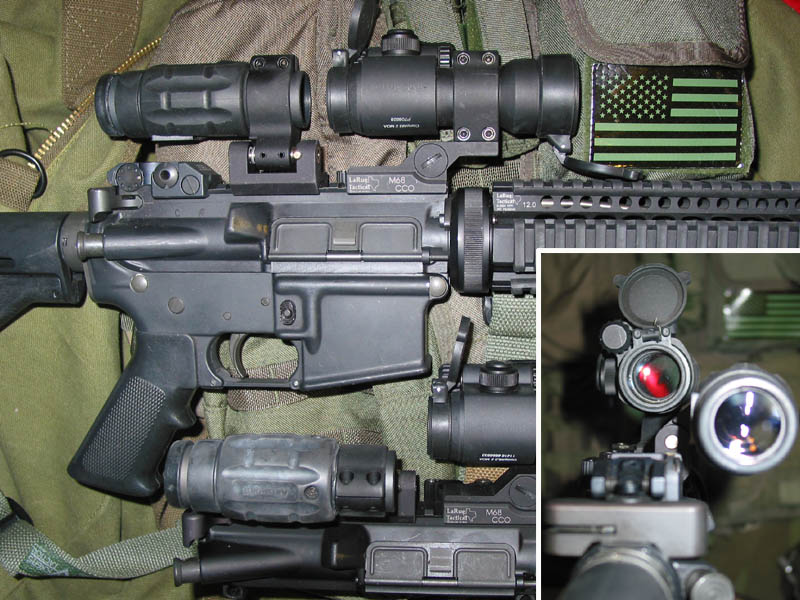
In this era, you need an optic on your rifle—irons are no longer the first choice. There are lots of optics available, however, for a typical AR style carbine, the clear best choice is an Aimpoint with a 3x magnifier—this serves all your needs from zero to 300. Yes, the EOTECH reticle is nice, but as noted above, it’s ideal if an optic always works and it doesn’t need batteries every few weeks. ACOG’s are OK, but as the Marines are finding out, for under 25 yd shooting they are not optimal and not as versatile as an Aimpoint/magnifier combo. The S&B 1.1-4x Short Dot is a great optic with incredible versatility, however, it is very expensive, and may not be the best choice for typical LE/Civ usage as one shooter discovered in the class. Bottom line–get an Aimpoint Comp M3 or M4 and be done with it. For those on a budget, get the C3. For those running lightweight compact SBR’s, the Micro T1 is a great option. The LaRue mounts are the best way to go. Likewise, stick the Aimpoint 3x magnifier in a LaRue LT649:

If you want a VFG, mount it as far forward as possible and don’t “choke the chicken”, as Pat Rogers would say. Use a thumb forward grip and pull back against the VFG with edge of the hand.

If you have a malfunction under 25 yds, transition to your pistol!

What rifle? For kicks, I brought a early SPR upper from a well known custom vender that we had only previously only used for long range shots on gel blocks—It is very accurate, but promptly began to have failures to cycle in less than one magazine, as the screwed on gas block likely shifted, making it a beautiful bolt action AR… I finished the day using a standard 16” upper. Moral of the story—for serious use, keep your carbine simple.

Get a Colt 6920 16” upper:

– Add an optic, as noted above.
– Add a light, something simple and inexpensive like a SF G2L in a VTAC mount.
– Add a good adjustable 2-point sling, as Pat Ahern noted above.
– Add a PRI “Big Latch”/“Gas Buster” charging handle if you want something easier to use than stock.
– Add a FF rail if you want it—LaRue, DD, Troy, KAC, whatever.
– Add a VFG if desired; the Tango Down “Stubby” is the best of the bunch.
– Get a bunch of GI mags with Magpul followers and standard Magpuls turned 90 degrees (not the Ranger plates) or the new Magpul PMAGS.

You’re done. Go shoot. A lot.

Mr. Chapman, thank you for presenting a fine class! Oh, and an elusive DocGKR picture—there have only been a couple others posted online in the past decade.

Can you give us further Doc?