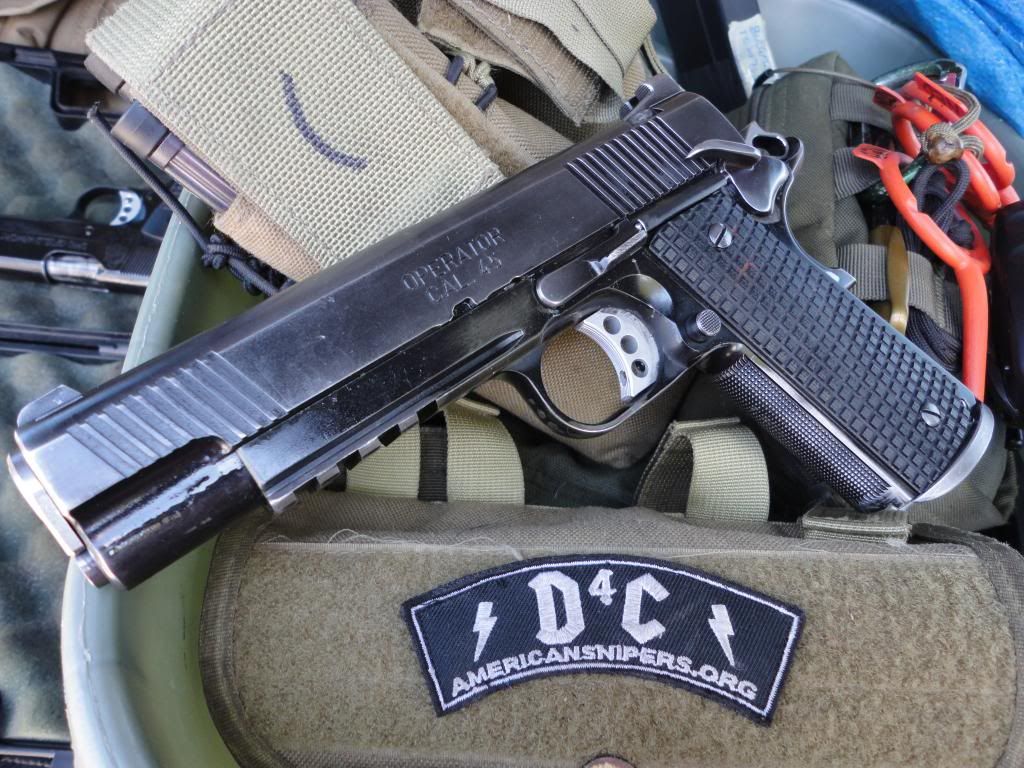
My SA MC Operator also has a “glued” ejector. I have been shooting it since 2010, with nary the round count of the above. It’s reassuring to see that the above Operator is still less a pin, even after all that usage.
I was worried about “glue” when I first made the purchase, but was reassured by a very savy Operator, pistol smith, and all around good guy, that his issued MC OP never had a problem. That was enough for me.
Really good to see the entire package holding up so well.
I prefer it to the “Glamour Shot” pictures I see alot of 1911s in.
Maybe I’ll throw a picture up of my first 1911,a (cough) Tarus PT1911 that has around 12k down the pipe. Still fist sized accurate at 25 yards, but ugly as sin.
It’s soon to be filled with Wilson Combat parts, just because I’ve never played with 1911s before
I think these pics are lost at least for now-- but I will be seeing Rob in June and get some updated pics and round count-- I would guess maybe another 5-10K but he has a few other 1911’s so maybe less. He keeps a precise count.
I was with Rob for a class in August (he was instructing, I was the mechanic). The trigger pull on the Operator had suddenly gone way up. I went right to the hammer and sear and other internals and started trying to figure it out. In the end it was a broken plunger tube stud allowing the safety to come up just enough to try and block the sear, making it hard to pull the trigger. I put in a new PT and everything was fine.
The plunger tube was a MIM part; current round count is around 80K (he knows wthin 5% but I can’t remember within +/- 5K what he told me). Darn good life for that or any part, let alone MIM. I’ve always said MIM is like any other process-- not done right it can make bad parts but they aren’t necessarily bad. Lots of other MIM parts on this gun that have not broken.
Is there any way we can get current pics of the Operator? There is nothing like a honest wear 1911…I have the exact model, and just received it back from the custom shop having it completely blacked out including barrel. It is good to know that the “evil MIM” parts that everyone wants to replace as soon as they get a gun are holding up like they are.
A friend at a local gun shop showed me a Springfield Armory 1911 Range Officer that has been used as a rental pistol for the past 2+ years. He said the pistol gets rented almost every day and he estimated it has had at least 10,000 rounds fired through it.
He told me the accuracy was almost as good as when it was new. I inspected the pistol and was surprised at how tight the slide to frame fit and barrel to bushing fit were. That speaks volumes about the quality of the SA 1911.
Rob’s comng for a visit in the next few weeks, I’ll get few more pics and we’re gonna put one of my ESPT’s on it:
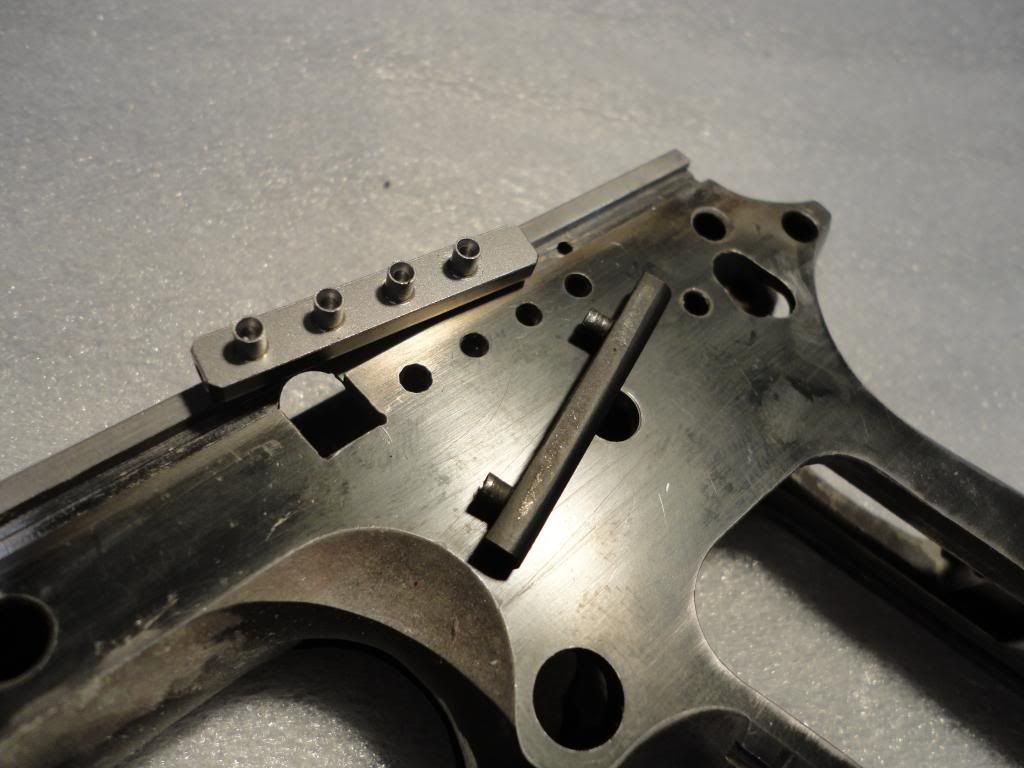
Showing the “four studs instead of two”. But it’s more than just that. On most plunger tubes the relationship between the boss and the factory holes they go into is, well, sloppy. That makes for an installation that can be even more marginal than it might seem. The ESPT studs are larger than most others by at least a few thousandths. The extra holes, put in with the available drill jig, are several thousandths smaller. This all adds up to a plunger tube and install that is way, way stronger than traditional plunger tubes.
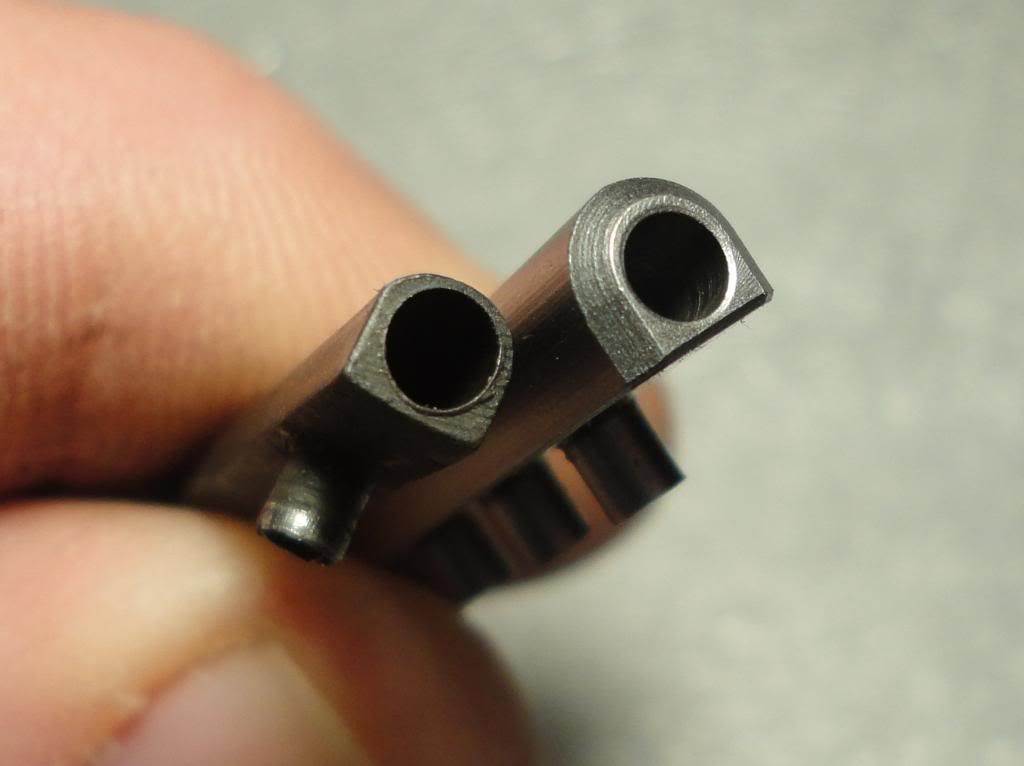
This one shows the increased thickness of the ESPT’s walls and the overall precision machining. The plunger holes are held to a higher standard for diameter and concentricity which can be a huge benefit in, first, getting a perfect safety detent effort, and second, in maintaining it. Between a better fit with the plungers and being made from prehardened chrome-moly steel, the hole does not get wowed-out with heavy use.