1000 yard .308 178gr loads

After nearly a year and a half of consistent irritation with
non-shooting bolt guns I finally got one that shoots, and decided to wring it out by taking it to a 1000 yard F-Class match last weekend. I was pretty happy with my scores since this was the first sanctioned match I’d shot in 7 years or so. I didn’t intend this to be a match gun, but I’m afraid the bug has bitten me.

I am having a little trouble getting the 178gr AMAX to 2650 (to keep it supersonic at 1000) with accuracy and a respectable ES (to be competitive at 1000 the velocity ES needs to be under 10, and to be truly competitive it needs to be around 5-7). The load I wound up using turned out to be TERRIBLE on the chronograph in terms of ES, but I did
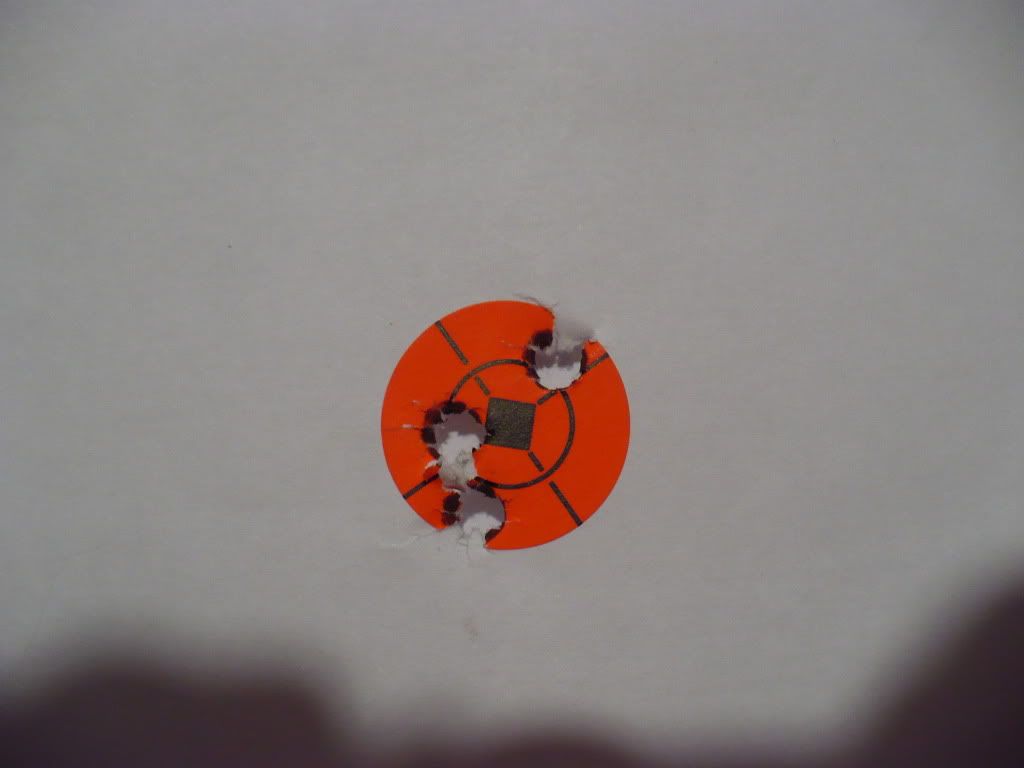
wind up with an X-count of 4, with three of those shot consecutively (you want to talk about a good feeling - put three rounds into a 5 inch circle at 1000 yards with a .308 in a constantly shifting wind and mirage. I was walking on air for the next couple of hours :-D). I didn’t get to chrono the load until after the match, but it took me 12
mils of elevation to get to 1000 from 100 yards, which indicated 2550 - which proved to be right on the nose when I chronographed it.

According to Exbal (and my friend in the pit) it was going subsonic at about 975, but the bullet was still making nice round holes in the target and more or less hitting what I was shooting at. The problem is that the load I used was not safe (I kept the rounds in an MTM box inside a lunchbox cooler to keep them around 40 degrees instead of 92
after I saw the flattened and cratered primer when I shot three at 10 PM the night before) and though they seemed to shoot ok at 1000, the ES was truly horrible and the primer looks like it was licking its chops thinking about taking out my right eye. So I’m starting more or less over, and I had a couple of thoughts that I wanted to run by the
assembled multitude.

As you know, the general rule is that you need to have your bullet supersonic at the target, or you’re out of range. However, some bullets do fly fairly true through the transonic zone, and it looks like the AMAX 178 might be one of them, at least at 92 degrees and 45% RH. Plus, I know some guys who are shooting essentially the same load out of 16" gas guns, which puts the MV at about 2450, and they’re getting hits to 1200. So what I’m thinking is that maybe I should stop trying to push that bullet faster than 2550 and just work on the accuracy and ES, and just quit worrying about the supersonic burnout range unless or until I start seeing screwy behavior at the 1k line. Opinions are welcome here. My gun seems to really like 43.0 of Varget - groups are dramatically tighter than any other charge weight I’ve tried so far.

I know I’m mixing my metaphors here by talking about a “precision rifle” in the military sense and working on match shooting as well, but it would be nice to have a load that’s usable in both arenas (I know it won’t be optimized for F-class competition, but I’m just doing that for
fun, not trying to climb the ladder in that world).

For reference - the load was:
New Lapua brass, FL resized in Redding die
43.0 gr Varget
178gr AMAX
Federal Gold Medal Match Magnum primer (GM210M)*
COAL 2.800"

*I did this because of the 50fps ES I was getting with the standard primer. Preliminary tests indicated substituting the magnum primer brought the ES down to under 10 - but that’s not what happened later that afternoon. When I chronographed the load after the match, the ES was 91!

I got some RL-15 and am interested in trying it to see if I can safely get a little more velocity, but it seems my rifle really wants to throw the 178s at about 2550 for best accuracy.

Thanks gents.

Ok I understand this thread of yours very clearly:)

As you know, the general rule is that you need to have your bullet supersonic at the target, or you’re out of range. However, some bullets do fly fairly true through the transonic zone, and it looks like the AMAX 178 might be one of them, at least at 92 degrees and 45% RH. Plus, I know some guys who are shooting essentially the same load out of 16" gas guns, which puts the MV at about 2450, and they’re getting hits to 1200. So what I’m thinking is that maybe I should stop trying to push that bullet faster than 2550 and just work on the accuracy and ES, and just quit worrying about the supersonic burnout range unless or until I start seeing screwy behavior at the 1k line. Opinions are welcome here. My gun seems to really like 43.0 of Varget - groups are dramatically tighter than any other charge weight I’ve tried so far.

Took me right at 5 months to self teach myself that exact thing I put in bold above. I can’t stress how much that’s what I’d do in your position.

I stopped myself from going wild in my imagination thinking about what happens to a bullet when it passes from super to sub in the transonic region, whereby it undergoes the “notorious” transonic “bump”…as somehow I conjure up every time some epic jarring of the bullet.

"I did wind up with an X-count of 4, with three of those shot consecutively (you want to talk about a good feeling - put three rounds into a 5 inch circle at 1000 yards with a .308 in a constantly shifting wind and mirage "

I have a little personal policy that I won’t count a distance as being effective until I get that magic number three…the difference b/t even a single and consecutive hits at 1k is significant, but the difference b/t landing a single round and then landing three in a row is night and day different. Some people just couldn’t imagine the tedious work, concentration, and overall technique in order to land rounds at 1k. Good shooting, and I would be very happy with that on a work up load especially.

It looks like your basically there…the 178gr. AMAX I’ve found is a beast from 800yds and out.

Congratulations! Hitting a 1/2 minute F-Class X-ring at 1,000 is quite a feat, whatever the platform.

Need a few details on your weapon (rifling twist rate and barrel length) and environmentals and atmospherics (range altitude and temperature). Your rifling twist may be marginal for the AMAX’s length – if you’re at the edge on velocity you can keep the bullet on true flight axis a little longer with a slightly faster twist (1-10).

The 178 AMAX is a really good bullet and flies fairly true through the trans-sonic bump. JBM Ballistic is a free on-line ballistic computer that will print out your drop and drift tables once you plug in your variables.

Never sacrifice accuracy for speed – you can push bullets fast that won’t hit squat.

There are all kinds of benchrest / long range techniques that can burn up time, give you perfectionist obsessive-compulsive tendencies, eat up your reloading tool dollar budget, and generally divert you from time on the gun.

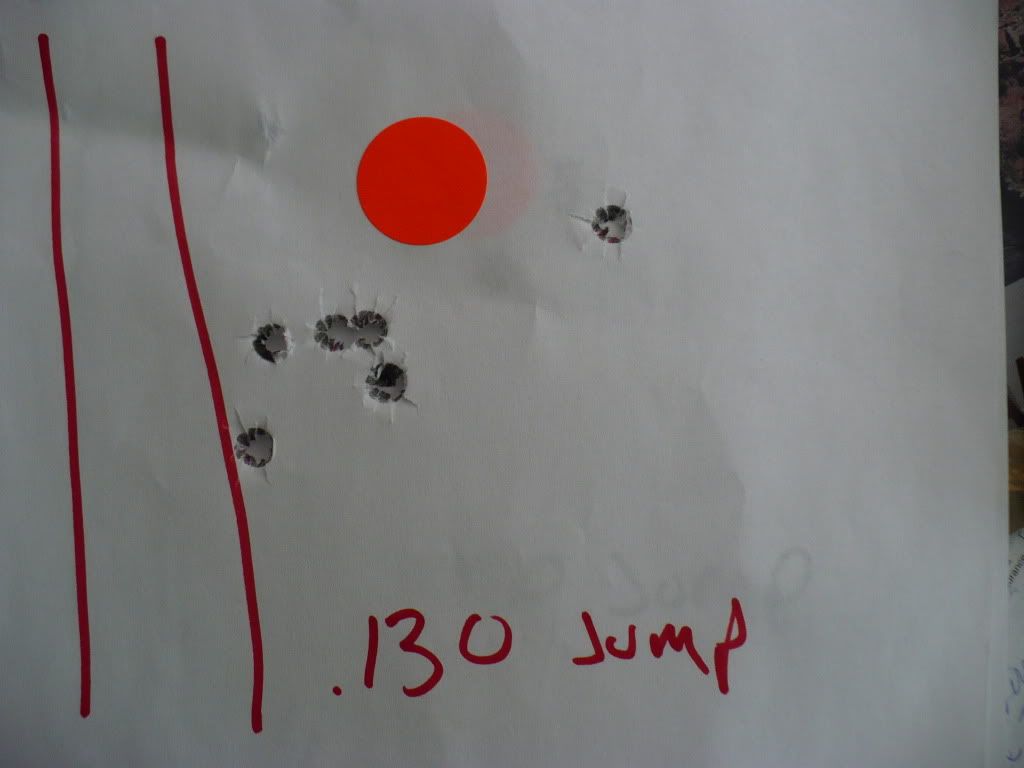
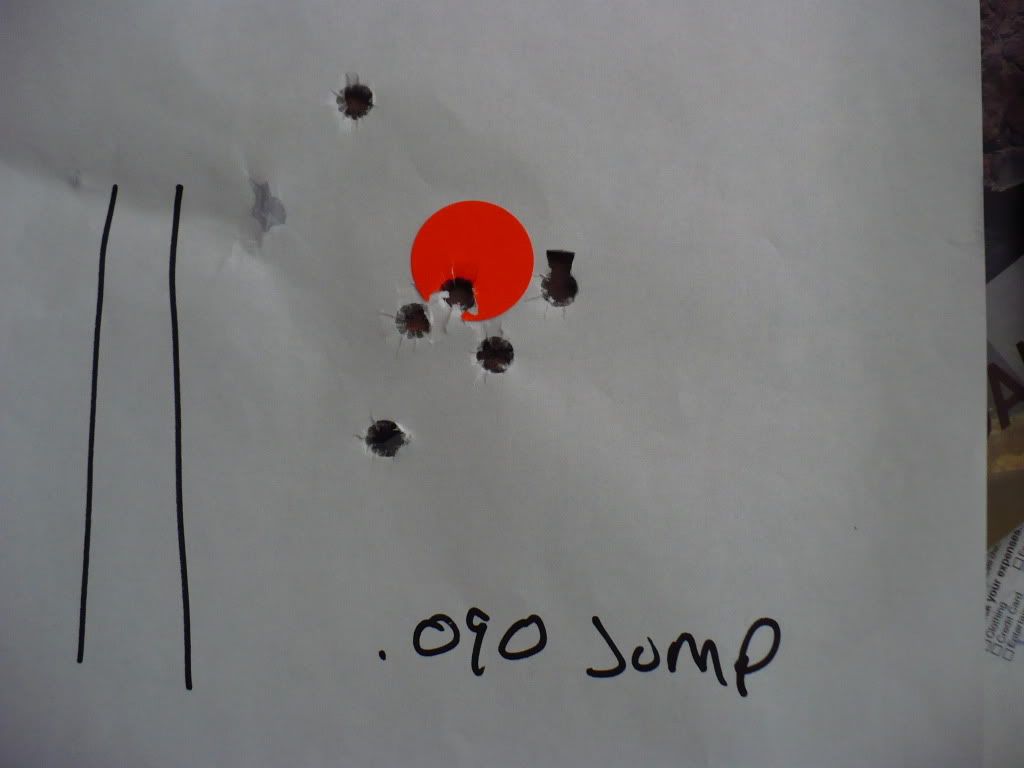
First, find out how long you need to seat the bullets to get just a slight jump to the lands. 2.800" might be too short and you may find you’re free-jumping between .1 and .25 inches before the bullets even start to get rotational twist, upsetting slightly off-kilter in the meantime. Your optimal cartridge overall length may be too long for magazine feed. If you can seat the bullet out further your pressure signs may go away, and you can bump up your charge.

Hand-weigh each one of your 1,000-yard powder charges on a beam scale and trickle the final powder granules so that they’re all the same. 1,000 and beyond is about consistency.

Lapua brass is going to be your absolute best bet, period.

Get yourself a good rear bag. Concentrate on consistent cheek and eye placement and make sure you’re not influencing and juggling the stock when the rifle actually goes off.

Good luck. It can be addictive.

Guys in our club are running 43.5 and even up to 44gr of varget under 175’s and 178 BTHP’s, but those AMAX are longer so they eat up powder volume.
You can also look at loading them a little longer to get more powder space, perhaps 2.850" OAL.
Also, look at the BTHP’s instead of the Amax in 178gr as the newer designed BTHP’s have a higher BC than the old 178gr Amax design…

Thank you, sir. Answers above in red.

The ES is all over the place with the magnum primers. I shouldn’t have been able to hit shit, but three consecutive x-es say something, I guess. I’m going to go back to a regular match primer and quit worrying about it, as long as it groups. I did my load development in a 100-yard underground range, so when I fvck up a group I know it was either me or something mechanical, since ENV is pretty much the same.

Accuracy goes to hell once I get above 43.5 of Varget. I thought I would try RL15, if anyone thinks that would make a difference.

ETA gratuitous range pic I took during a check-fire that was called so a UAV could take off from the runway parallel to us. The little grey dots off in the distance are the target numbers.

100yd groups really don’t mean squat at 1000yds, ESPECIALLY when shooting 178’s from a 1:12 twist barrel.
Re-do your development at 400 or at least run a ladder test at 600 and see where your nodes are.

I’m also convinced that most consumer grade chronographs are not accurate enough to truly get good ES and SD readings.
What matters is the vertical dispersion on target, not the measured velocity spreads.
Measured velocities don’t make holes in targets, bullets do.

I’m beginning to see your point there. My chronograph is a PACT Professional XP, which while not Oehler grade it’s no “Shooting Chrony”.

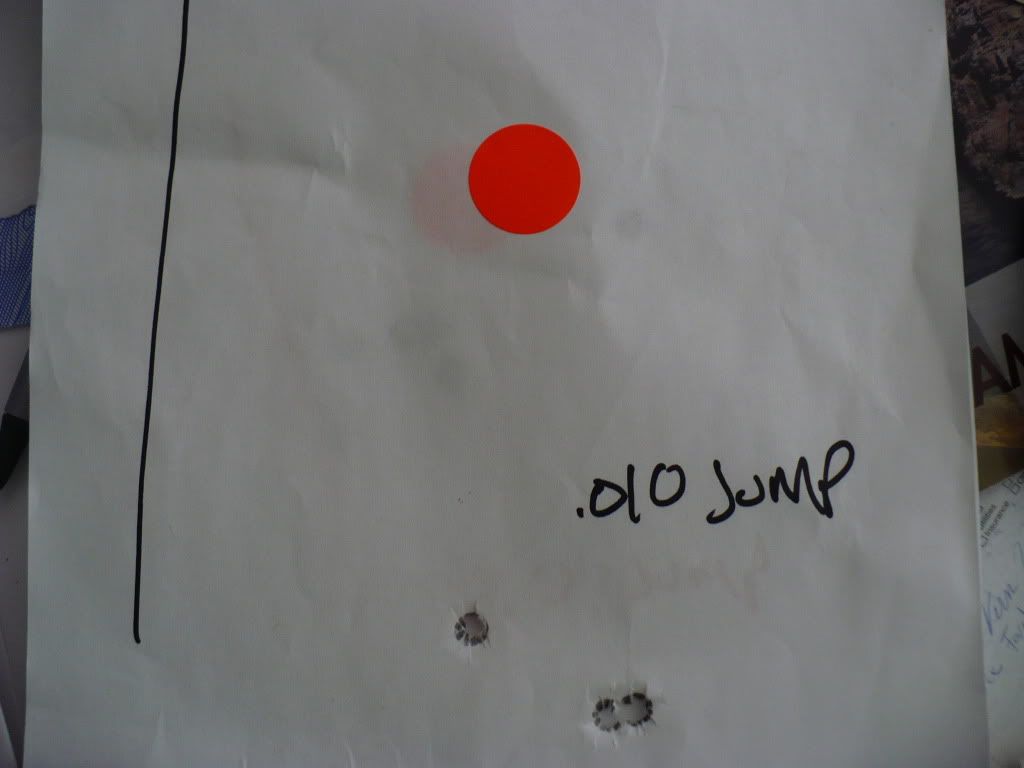
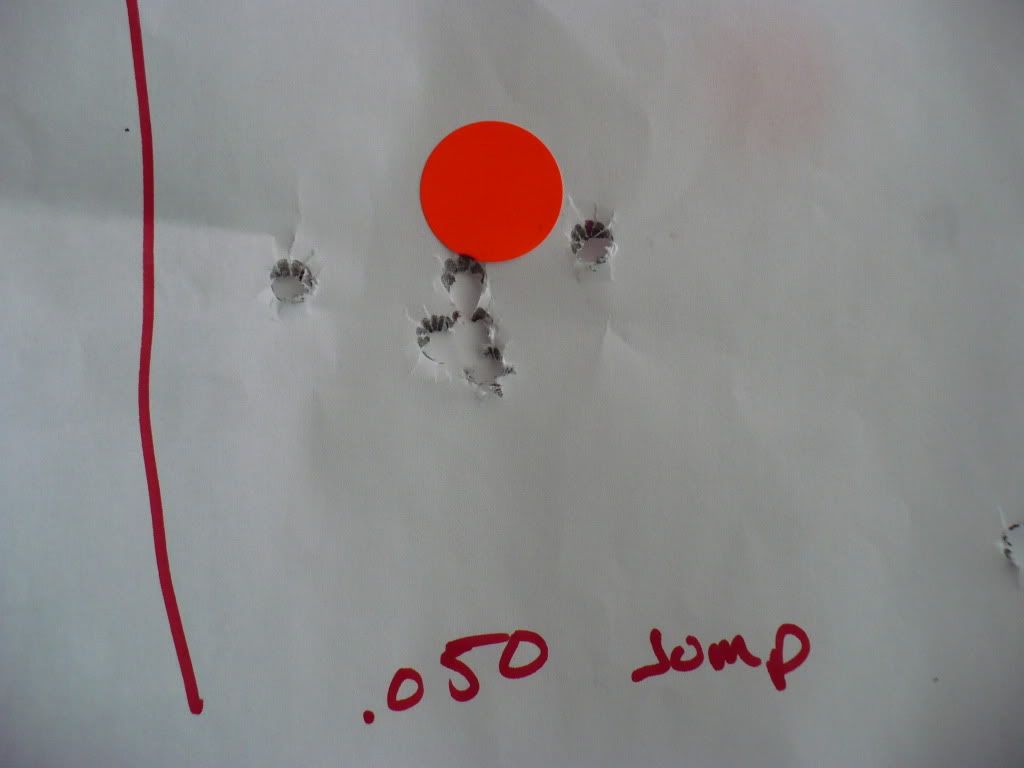
I will indeed try it at 400, since I have that range set up already. The last group I fired over that was at dusk last week with this same load, and it was just drive in, flop down on the ground and shoot, and go pull the target. I don’t know how much of this was wind and how much was me being pissed off, but here’s the pics:

Randall…outta curiosity would you consider a 35P proof screen above consumer grade? Slomo a fellow awesome member has been so nice to have loaned me a 35P now for some time, and I really trust this unit, but then again I certainly don’t know very much about chrono options.

Also Sinister mentioned a huge thing that I didn’t even consider, and I’d imagine that mine and your mileage will vary now being that I just assumed you were sporting a 1:10.

Ultimately only one way to find out, and that’s not the internet;)

Yes.
The proof channel is basically a 2nd measurment point.
I have gone so far as to shoot through two chronographs stacked end-end and then compare the velocities.
When they match, I consider those accurate measurements, or at least equally bad measurements.
When they are different, and there is a trend associated with all of the shots combined, it’s easy to see what are probably outliers…

Some of my best groups ever are shot like that.
You are fresh and don’t get time to be head fucked.

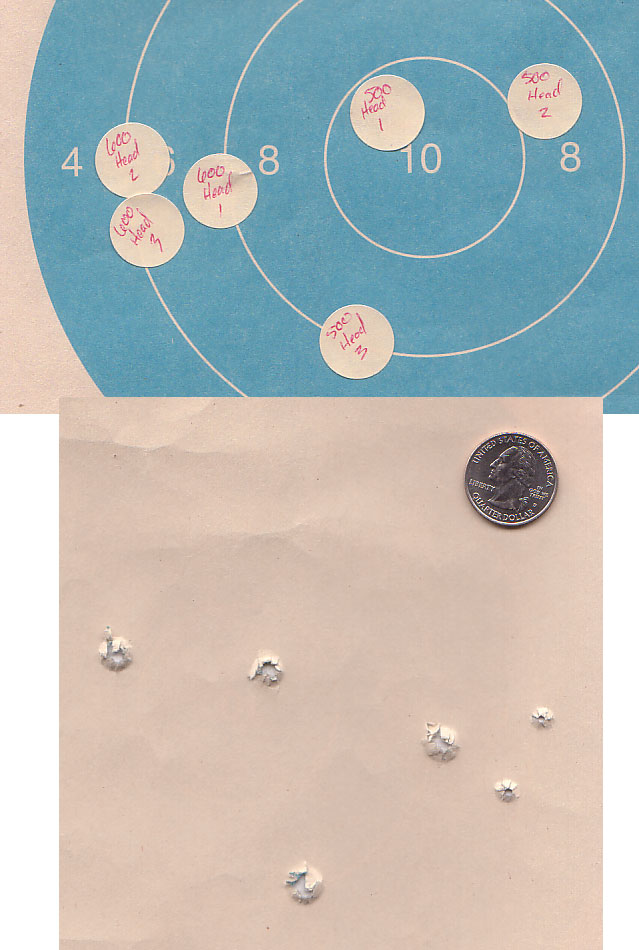
This is two different 3 round groups fired under time constraints at 500 and 600 during a match:

It’s only 6 rounds, but even still, it creates a trend where the group is flat across the target.

One group, especially a 3 round group, won’t tell you much.
What you want to see is a combination of perhaps 20-40 rounds fired and THEN look at the total north-south dispersion on target from the central aiming point.
If there is any wind, the east-west dispersion SHOULD always be larger as that’s the wind fooling with you.
Without wind, the overall group should be round.
If you get round groups in the wind, you either have too much ES or you are one hell of a wind shooter!

Sounds like you already got a bunch of great advice but I will add a plug for trying the R15(its used in the LR118 round if that pushes you over the top). Just load some up and check out the diffrences.
3 rounds 140g AMAX 260rem at 900 meters off a bipod(the three in the center)

This is that rifles 200m zero the dot is 1"

The results of a seating depth test on beger bullets just so you get a idea, fired at 200m not all bullets are effected by this


OK, guys…check it out. I just got in from a 16-hour day at the range and at the reloading bench.

First a big THANK YOU to everyone who has helped up to this point - and a special thanks to AR15barrels who put the bug in my ear about tuning at 400 for vertical and more-or-less ignoring the wind for the moment. That was the single best piece of advice that I have listened to in a long time. And the next best goes to whoever suggested trying the 178gr HPBT. Holy shit, that’s not just a little different from the AMAX, it’s a LOT different. Third best was quit being a pussy and push that thing a little. What I found out was that loads that would probably smoke primers in my gun with the AMAX yielded completely normal-looking primers and case heads with the HPBT, and will leave me enough velocity at 1000 to actually get to 1200 supersonically.

Left the house this morning and I picked up a couple of hundred 178 HPBTs on the way out to the farm just to give them a spin, but not having read much about them I didn’t think they’d be much different from the AMAX. My intent was to shoot my then-current best load (so I thought) at 400 to check out its vertical dispersion. On the way out, I loaded up 5 HPBTs using the same data (43.0 of Varget) and went outside to the range and fired ten rounds at 400. Meh. 5" and a little bit of change. No good. So, says I to myself, I’m going to start pouring on the throttle and see what happens. I start going up in .5gr increments watching for pressure signs, and left the chronograph in the box for now.

As I kept increasing my charge, a funny thing kept happening. The vertical ES kept shrinking…and shrinking…and shrinking…I started going up in .2 increments now…and shrinking…then BOOM it opened back up again. Back down to the load giving the smallest vertical ES (these were 5 round groups), and it does it again - 1.741". I look at the primers and cases, and they look exactly the same as they did at 43.0 - no flattening, just the slight cratering I was experiencing before, no ejector rub marks (though those look different in an FN, because it’s a slot rather than a plunger). YGBSM, I think to myself.

So I run it back to 100 to chronograph it - and I get a .133" 5-round group, and a velocity in the believable range for the charge, I’m just amazed at the lack of pressure signs, especially since it’s 95 degrees and bright/sunny. I’m pushing this 178gr HPBT to 2730 with no pressure signs. Now I’m curious, and I look up the BC - according to Hornady it’s .530 (again, holy shit) which if BulletFlight isn’t completely dicked up means that it should arrive at 1000 traveling 1400fps, taking 9.3mrad of elevation to get from 100 to 1000. For fuckin’ real?

I go inside and start processing brass, and I load 5 rounds of the best load in unfired brass to shoot at dusk when the wind drops off. I went out at 2100 and there was still some 1-4 variable winds, but I figured I’d take a whack at it anyway.

I fire off five quick shots and race down the levee to pull the target.

Result: Vertical ES of 1.189", and a horizontal spread of 3.29".

SOLD to the man with the green FN!

The winning load:

Hornady 178gr HPBT
New Lapua brass
New CCI BR-2 primer
45.9gr Varget
COAL base to ogive 3.133" using Sinclair ogive tool
Loaded round neck OD .337"

Loaded on a Redding T-7 with Redding standard dies, charges weighed with a PACT combo scale/dispenser. I threw back anything that wasn’t dead nuts on 45.9gr.

Avg. MV 2730fps, and I no longer trust the ES reading on my chronograph, so I’m not going to give it. I will say, however, that 2.1 mils of elevation indicated by BulletFlight to get to 400 from 100 was dead-nuts on the money, so I’m going to guess the velocity is correct.

Gun is a 24" barreled FN A3G, 1:12 CL barrel.

I spent the last two and a half hours loading 100 of them for the match next weekend. Hand weighed each charge, etc.etc. The only question I have now is that the Redding seating die seems to be leaving some kind of circumferential mark on the ogive - do I need some kind of special VLD seating stem for these bullets? The AMAX never has any marks. They don’t seem to affect accuracy, at least not at the level I’m operating at, but I can’t imagine they’re adding anything.

EXCELLENT!

Looks like you hit the jackpot. The Redding will leave cosmetic markings (no big deal). You could spend money sending them back to Redding, swap them for Forsters – or not worry about it and keep slamming targets. :smile:

Keep us updated as you build more data! Some day (eventually) you’ll burn out the barrel…then you can try a 1-10 twist and 208-grainers.

I think that might have been me in post #4 of this thread…

Glad it’s working out for you.
In another life, I help run the california precision rifle club…
www.caprc.com

Dosent that PACT powder station piss you off? I have the RCBS one that looks identical to the PACT. What a POS I always dial it for lower than my charge weight and trickle up.

I think I told you in the last thread that 100yards was a NO GO

It fucks up about one charge out of three. I hadn’t thought about doing it that way - I don’t think it has a trickle button, though I could be wrong about that.

And you probably did - I usually have to be told a couple of times for something to sink in:D

on mine if u hold the dispense button down it trickles

No shit. I’ll try it. Sounds like a better way to go than dumping 30% of them back in.

And another match this weekend - all shiny new Lapua brass, loaded and ready to rock. I’m REALLY interested to see how much better these HPBTs fly than the AMAX. I shall return with data.