I know this has been discussed before but I can’t find anything that relates to my paticular question. As I stated in another thread I recently switched from an absolute co-witness mount to a lower 1/3 mount and re-zeroed to the 50/200 that I had been using before. But I noticed that my impacts are now higher at 100 yards than before. I’ve noticed some of the high end-users recommend a 100 yard zero anyway. I’m considering going to the 100 zero but would like some thoughts from you guys that are using this zero in comparison to the 50/200, and does anyone have any trajectory info that show the difference between an absolute and lower 1/3 set up?
What will the main purpose of the rifle be?
It’s primary use is for home/self defense but it is also used for training, and occaisionally hunting.
Per JBM Ballistics the difference in impact (assuming a 200M actual zero) for a sight hight change of +0.2" (the ~diff for absolute and lower 1/3 co-witness) is only 0.1" at 100. You probably just zeroed it a little different with the new setup.
As far as 100 VS 200 Yds/Meters for a zero - IMO it makes absolutely no difference so long as you stay with one or the other.
I’ve zeroed everything (RD, scopes and irons) at 200M for decades so my POA at 100, 150 & 300 is somewhat ingrained. I enjoy wide open spaces to shoot in however, so what works best for you might be different.
you have a flatter trajectory for longer with a 200m zero… 100m zeros with 5.56s coming out of this platform are petty impractical. your holdover at 300m is like three times what it is with a 200m zero. with the 200m zero, your maximum hold-under is like 5" or less. so basically, you can pretty much just set your dot on target and fire, anywhere between 50-300 meters. just going from memory- i’m sure somebody will post a chart that better articulates.
When you say “50/200”, which is it, and how did you achieve it?
It means that at 50 and 200 your trajectory are basically the same point.
m193 will be less than 1" up or down, at either, with either, IIRC.
“basically”? Just how “basically”? When you zeroed at 200 and then checked it at 50, how far off were you? How different was the POI at 100 when you first got POA/POI at 50 vs. when you locked in a zero at 200? Is it even possible to get a “zero” at 50? What size groups were you getting at 200? With what optic? What ammo? What barrel?
these are all intentionally leading questions, because the internut convention of the 50/200 is a myth, and generally completely misapplied and untested by most who use it and advocate others do the same. Simply getting POA/POI at 50 and calling it a day is not adequate, however I suspect it’s what the OP did, hence my questions in my first post.
On the subject of the thread title…
I have moved to a 100 yard zero for my carbines. I believe that the 200 yard zero is the better rifleman’s zero, and I believe it’s the better all-purpose, minuteman, EOTWAKI, etc. zero. But I have still moved to a 100 yard zero.
I ultimately don’t think it matters one iota which zero you choose, and I think that the far more important thing is to pick one or the other, get trigger time with it at all distances, learn the hold-overs/unders, and learn the benefits and limitations of your choice. Oh, and become a good enough shooter to understand and utilize natural point of aim, sight picture, and trigger control, to really have confidence in your shooting ability so that you’re not chasing your zero all over the target.
While the 50/200 is a guide, it’s hardly a rule. With a 50 yard zero, you should be fairly similar, WITH ELEVATION ONLY, at about 225-240-ish. That said, for a short distance/fighting rifle, I like a 50 yard zero but know your POA/POI from 0 to 300. On my competition rifles, I do a hard 200 yard zero and then know POA/POI from 0 to 500.
I use a 100 yard zero on my bolt rifles and then dial from there so I might be a small hypocrite. 
Hope that helped.
Rich
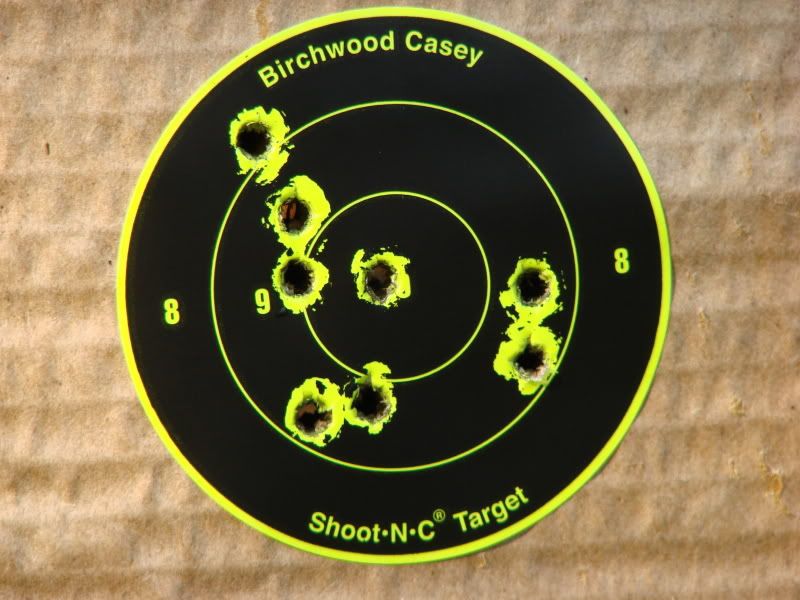
Here is my initial 50yrd zero group.
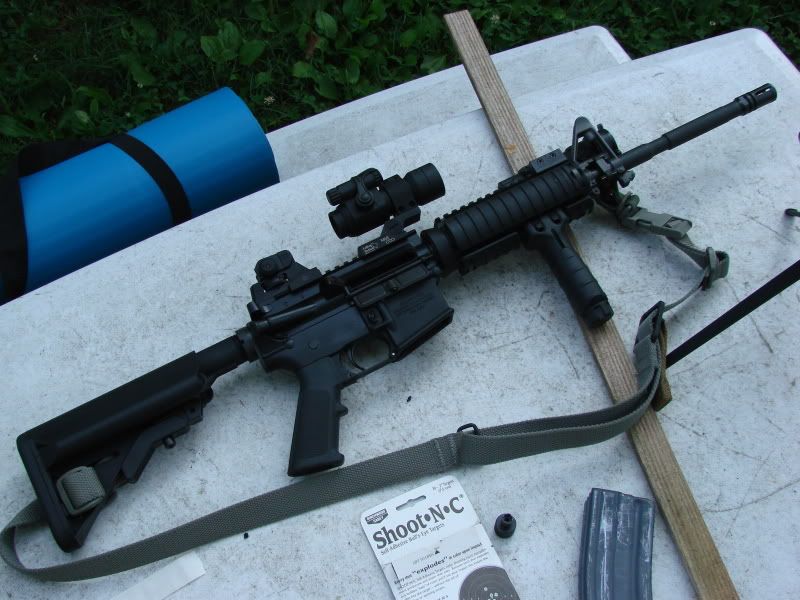
and here is my set up. Ammo was Win. Q3131A. I’ve always zeroed at 50 at home and shoot at 200 when I get to the range to check/confirm at 200. The environment here in east TN doesn’t present many 200+ yrd shots so I’ve always concentrated at 50 but my groups at 200 have always been good enough to take, say, a coyote at 200 which I’ve always been satisified with. I stock 55gr ammo for price considerations, most of which is Prvi M193. My carbine is much more accurate with Prvi 75gr match but I have very little of it so I don’t zero with it. On the last range trip I shot at 100 just to get the feel of the new Larue mount and was a little puzzled with how high my group was. Due to the extreme heat this summer I didn’t concentrate much on my goups, in fact after less than two mags I was content to set back and drink water to replace the fluids I was losing. As the weather is now begining to ease a little I’m kicking around the idea of trying a 100yrd zero.
Rob, what was your reasons for going to a 100 zero?
Again, any ideas or suggestions that may get me thinking out side the box are welcome.
.
jhs1969,
If you have’t seen the info in the Link to the Thread below, take a look, it is recent, very informative and may answer your questions.
.
I set my rifle at a hard 50 yard zero, the 200 yard zero falls closer to 230. Ammo was plain old PMC 55 gr. FMJ, rifle set up with 2 moa Aimpoint, 16 " midlength.
I understand your question about group size at 200. If your group at 200 is say 6-7" how can you verify the zero? Is that your point?
My personal opinion is that the 100 yard zero is the most appropriate for civilian use. I am also of the opinion that it is probably best for police patrol rifle use, but I am out of my lane on that one so it is an unqualified opinion.
The 50/200 is a bit more versatile, but unless you have a justification to engage a target at 200 you are probably better with the 100. Soldiers, Marines and some other types would be better able to utilize the 50/200, IMO.
I agree with this. Understand how your rifle/sighting/ammunition combination works together at all relevant ranges.
Some folks’ definition “basically” is pretty sloppy. My 50yd zero results in a far zero of 205m (224yd).
My question is this: How would the OP changing co-witness methods in any way affect the impact of the round? With either absolute or lower-1/3, you’re still lining up the irons and the dot at the same sight height and presumably putting the same zero on each. The only difference is the height of the optic itself, which doesn’t matter with an RDS.
Am I missing something, or is the OP somehow doing something different that’s inducing the results he’s seeing?
we’re not talking about hi-power zero, we’re talking about battle zero and hits with irons. with a 50m zero, you should be on torso at 200. doesn’t matter if your “zero” is 190, 210, or anywhere in between, for non-magnified sight purposes.
slightly oversimplified? maybe… but it’s not a “myth.”
My carbines are still up initially with a 50 yard zero and then I shoot at 200 yards to confirm. Typically, I’m a little high at 200 which should put me back on at about 225 or so and I’m about 1 1/4 ~ 1 1/2 high at 100. I know I’ll be hitting low for the real close in stuff. By as much at 2" sometimes.
My FAL with the H1 is set up initially at 25 yards I reconfirm at 50 and 200 for similar results. I’ll be about 1/2 ~ 3/4" low at 25. About 1 1/2" high at 100 and on at about 200.
With irons and straight RDS, I like this set up. The rifles are pretty consistent so I don’t have too much to think about when I’m aiming and switching between the two types.
If I shoot smart, I’m consistently clanging the 8" discs at 200.
Impractical for who?
I think that is one of the most important questions to ask yourself when choosing your zeroing distance on your rifle. What distances are YOU likely to be required to make engagement at?
If you are unlikely to need to make a shot out past 100 yards, then is a 200 yard zero really practical for you?
Jay is correct in that for LE use, the 100 yard zero is very practical. With a 100 yard zero the bullets trajectory never travels above the line of sight.
And as Rob said, just pick a “zero” and go with it. It is more important that you pick one, and go out and get some good trigger time with your rifle, your ammo, and your zero so you know where your equipment will hit at any given distance.
Zeroing your rifle, and knowing where your rifle/ammo combo will hit at any given distance is one of, if not thee most important aspect of learning how to fight with an AR platform rifle. It should NOT be considered a formality.