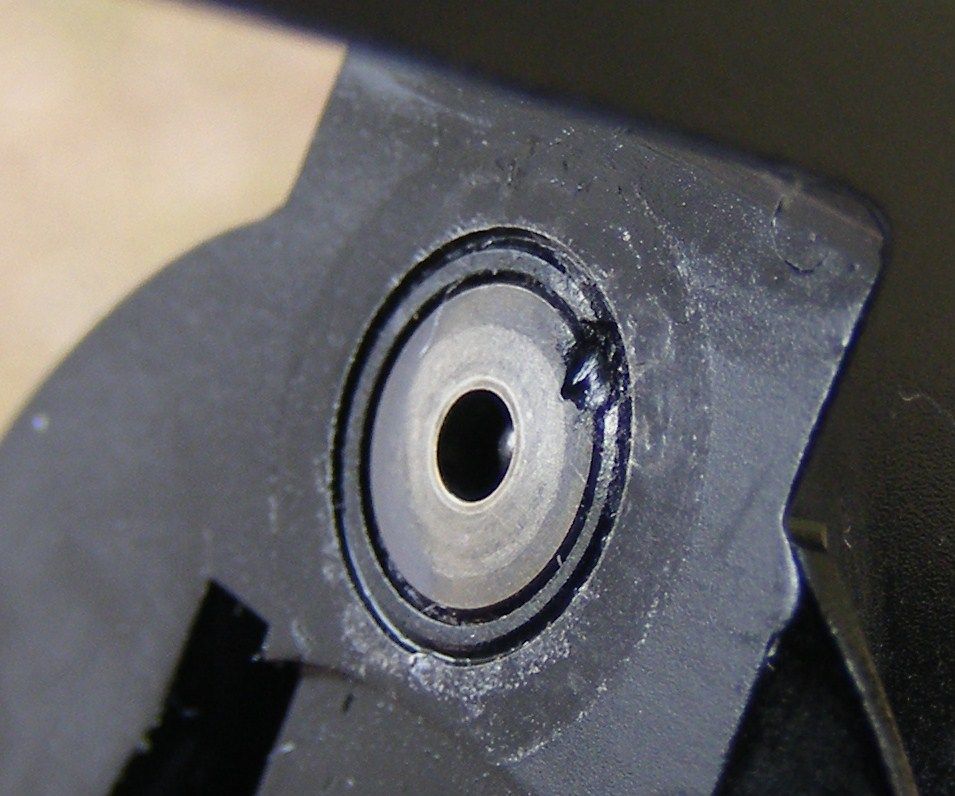
Earlier this summer, I found some unusual wear on the hammer nose bushing of my S&W model 442-2. It started as minor deformation at or about the viewer’s 3:00 position (shooter’s 9:00) in the photo below. As it was causing no issues at the time, I elected to watch it as it progressively increased to what you see pictured.
In early August, I shot 94 rounds through this 442 during an IDPA match. After the match, I noted all new deformation at 6:00 on the bushing. There also seemed to be a faint crack developing across it, but I was unable to capture it in the photo.
This gun is serial number DCU####, in service since ~04/2011, and has fired 1,819 rounds to date.
L/R View
Fast response from my S&W LE rep got a call tag to me quickly (8/11) and I shipped the gun to MA. I heard back from the factory on or about 08/27 and learned the gun was not repairable. Staff in MA requested an FFL for shipment of a replacement, which was transmitted with receipt confirmed on 08/29. Noting that the gun was a no-lock 442, a replacement without a lock was specifically requested. Status checks to MA thereafter on 09/08 and 09/22 have gone unanswered.
As I await that response and replacement, does anyone have any theories on causality? Is it a simple part quality anomaly, or are there other visible indications of a larger issue with this particular frame? Armorer inspection revealed all else to be in spec, with no excess play or other problem. A check of a couple dozen other Js shows no similar wear patterns. That includes a 642 BUG at ~2k rounds (documented), and others with higher counts (reported). I do perceive some greater visible wear compared to some of those others, but that’s subjective.
I will be interested to see the outcome on this. I’ve worn out a series of J-frames. Mostly finish wear and they get loose over time (shooting with +P rounds). A brand new Model 36 ($75.00 NIB), a NOS M40 Centennial (pinned grip safety & Tyler grip adapter) and currently a S&W 642 with Crimson Trace grips. Carry has been on ankle (Jack Ass Leather and Alessi), shoulder holster (Bianchi) and pocket holster (Galco & DeSantis). My daughter uses one as a second gun and deep concealment.
I’ll keep high hopes for some outstanding customer service on this one.
Looks like the kind of erosion expected with gas leak around the primer but it would be surprising to occur at such a low round count and considering that bushing is steel. For comparison my j frame is a 60’s era model 36 with a conservative estimate of 20k through it with no signs of damage
Like that. I will go with some defective metallurgy
An irregular surface on the firing pin nose could cause gas leakage through the primer. If you did not notice any pierced primers or other tell tale signs, such as small black soot marks, on the cases it probably was not the nose.
Another possibility would be that the firing pin protrusion was too pronounced and pushed the edges of the primer back against the bushing. Sometimes you notice a little extra drag when opening the cylinder when this occurs.
Elsewhere, the use of various ammunition types (esp green ammo), other ammo causality, and cleaning products have been suggested as possible causes.
Here are two views of the 642 I mentioned earlier in this thread. Serial number CBW#### has been in service a few more years than the 442, and has about 2k rounds on it. The 642 and 442 have fired similar types and quantities of ammunition, and used the same cleaning products. Cleaning products are primarily WS-CLP or Slip. Also of note, after I acquired the 442, the carry and use of either was pretty random.
I think the likelihood is that there was something metallurgically wrong with the 442’s bushing (i.e. over-hardened to brittleness), and that’s why Smith said it was non-repairable. I’ve never seen damage like that where parts of the bushing appeared to be “missing” or “caved in”.
I had something very similar happen to my 442 no lock. Seems like I had very few rounds through it too, maybe 50 or so. S&W said mine was non-repairable also and replaced with a new one. It’s been a few years ago though.
It took a bit of digging, but this is what I found. Purchased 3/24/09, serial number DCU2353. I also noted approximate 100 rounds of Speer Gold Dot 135+P fired through it, only ammo used.