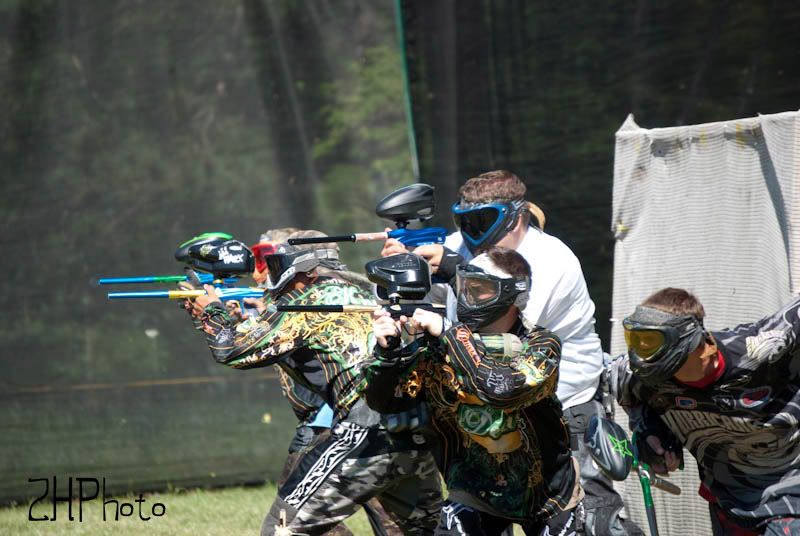
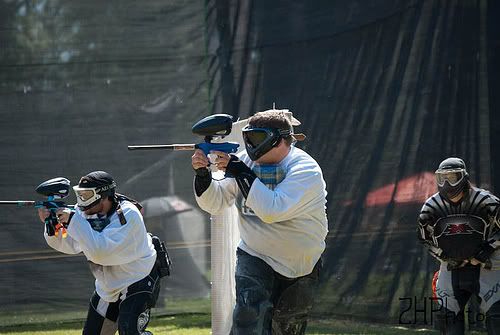
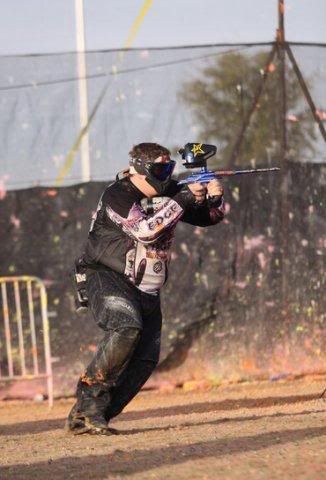
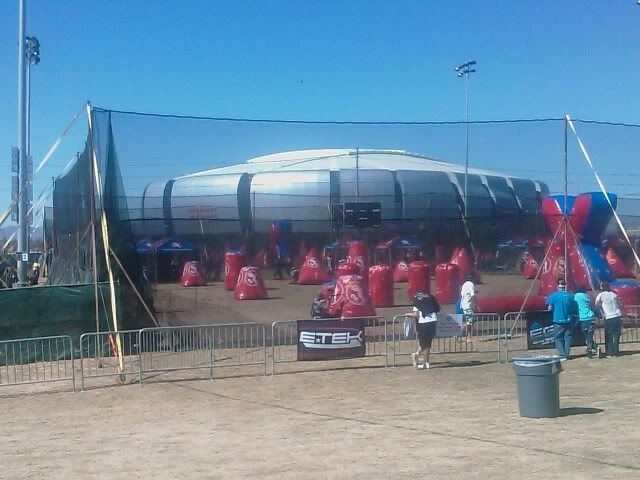
Ok, first things first before anyone gets their panties in a bunch.
Paintball is in no way a firearm substitute. Playing paintball (especially how most people do it) is as unrelated to actual combat as watching porn is to actually having sex. Now, with that out of the way, if done correctly you can learn some things from paintball.
Basically it is a “poor mans” or “civie” simunitions where you can practice certain skills that you cannot practice with firearms. The key difference is accuracy / velocity and the fact that you don’t use real weapons modified to fire simunitions.
For purposes of this discussion I will be talking about the US Army Alpha Black.

It is the same paintball marker in use by the US Army for some of their scenario training. Now to be quite honest I suspect much of the Army “paintball” stuff is a recruiting tool used to get paintball guys to places like Iraq, but there is also the consideration that it is far more cost effective than simunitions.
http://www.usarmypaintball.com/
In any case the average paintball marker is chronographed at 300 fps which is about half that of simunitions. In addition to that it fires a round ball from a smooth bore so it has all the disadvantages of a smoothbore musket vs. a rifled barrel. The practical accuracy you can expect at 20 yards looks like this.

Basically about a 12" group, so definitely a minute of man rather than a minute of angle situation and once you go beyond 50 yards you might as well be shooting paper airplanes and kites at people. Being able to hit anything inside your RDS field of view ends after that range and there is quite a bit of variation in flight of the projectile. That said, it is still dramatically superior to things like airsoft which have extremely dismal accuracy. The typical marker is also quite a bit lighter than your average M4 carbine but if you run a 20 oz. tank on the marker it is comparable.
There are also some dangerous habits that can be learned from paintball. 200 rounds hoppers make people trigger happy where they succeed simply by throwing the most paint in a general area until they get lucky. People hide behind cover that would never actually be cover if real rounds were flying. They also tend to run in the open at “safe ranges” of beyond 50 yards. And there are of course any other number of ways to treat it as a “game” where you would learn dangerous habits.
And of course your average paintballer tends to believe he has some kind of combat experience, but if you dropped him into Somalia with his “team” the realities of combat without rules would quickly teach them a short lesson they wouldn’t survive to profit from.
But despite all those limitations, there is something for the civilian shooter. It is a way to practice some force on force techniques that simply don’t exist at the range and it is an opportunity to actually put on all that gear and run around with it, something the armchair commando has never done and something most shooters don’t get a chance to do.

To understand the significance of the value of paintball training we must think of shooting at targets in the same way as a boxer or martial artist hitting a punching bag. Even if the target is moving, it is still just a target and that target will never engage you. To quote Bruce Lee…“boards don’t hit back.” Paintball is more like “sparring.” It isn’t exactly the same as real fighting, but you can definitely learn some things about real fighting by doing it.
And trying to shoot a guy who is trying not to get shot and is in turn trying to shoot you can teach you quite a bit about a few things, especially if approached in a serious and practical manner.
We tend to play simple team elimination at night in the woods. This is obviously not something you would want to risk with real firearms modified for simunitions even if you could get them. We play a stealth game where targets are searched for, stalked and engaged. In many cases they are engaged in a coordinated manner by teams using radio communications.
And just like in real life you miss some guy and he lights everyone up or your plan goes to hell and you have to improvise something. All valuable training skills that you can’t learn at the local rifle range. It is one thing to shoot accurately from the line at the range, or even during a stage in a practical shooting exercise, but it is a much different experience to haul ass 75 yards in a flanking move and try and hit two guys who are on the run trying to get to cover. And if you’ve never done it, you probably aren’t very good at it.
Some things that can be done to make it more realistic is to use 30 round loaders so you only have that many in your hopper at a given time. We’ve played many games where nobody reloaded another 30 rounds before everything was over. We count only hits and not sprays from hits on nearby trees or your weapon. But at the same time we count hits on a person even if they don’t break. Basically the bullet rule.
And of course paintball does allow for far more regular training than live firearms. This includes all the various rifle drills you currently do, but now can do in your backyard. The trigger won’t break exactly the same way and there is no recoil. But putting the RDS on your target and firing on that target tend to be something of a constant. Being able to do “move and shoot” exercises 5 times a week is something most people don’t have a chance to do, nor can they afford to even if they wanted. With paintball you can.
Being able to practice coordinated team efforts and related tactics is just another bonus. So if you have some regular shooting buddies, consider grabbing some alphas and coming up with some practical shooting exercises, just don’t try it indoors.