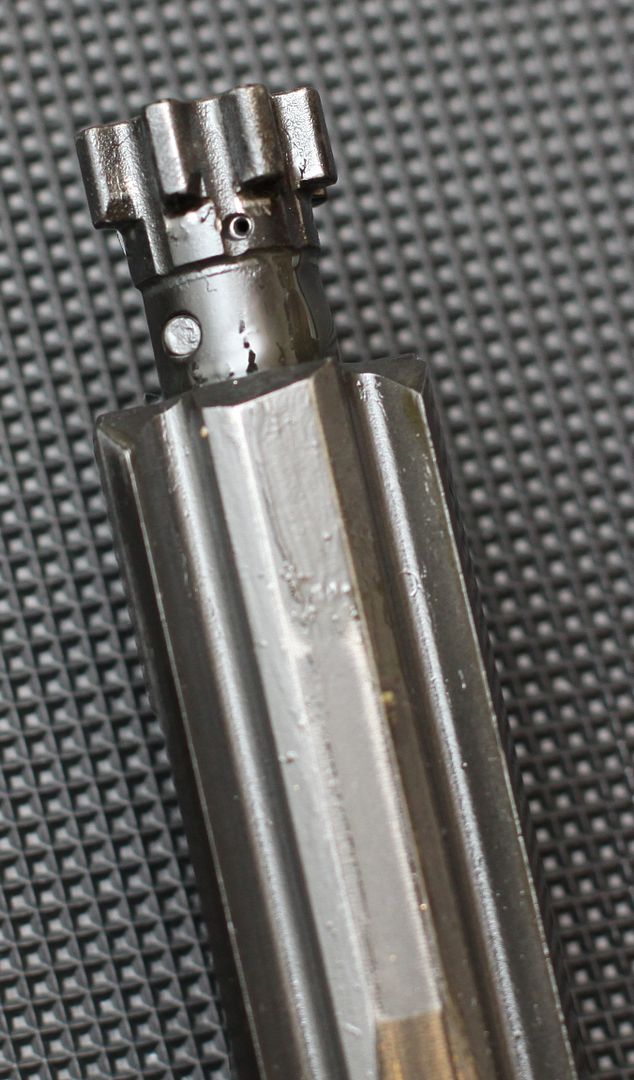
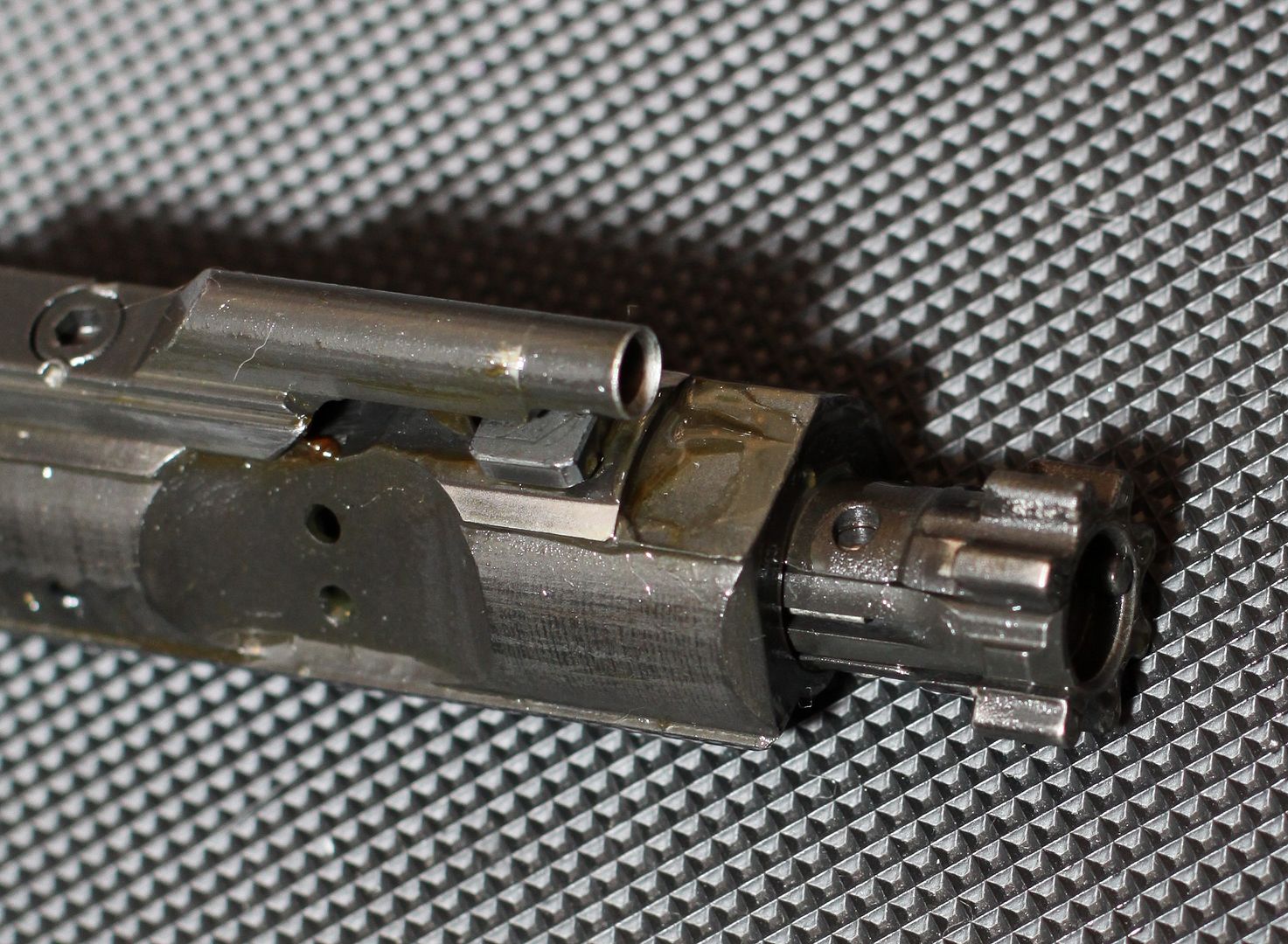
I just received my SR-15 E3 IWS Upper. So while looking at the bolt I noticed a few things. First off no dirt groove on the bolt face. That is no big deal. Overall, no problems with it. But I did notice something different about the extractor that I have not seen on any of the various photos on the 'net. The exterior portion of the extractor has a groove with a small metal rod through it. I would assume this is for strength but it does not attach at the front of the extractor.
You can see it here in this photo I found.
Anyone have any idea as to what it is for. I am sure it is there for a good reason. I just want to be educated on the function of it. Also, why did KAC do away with the dirt groove (no real added value, I assume)?
Interesting. Do extractor pins typically have problems with moving? I would think that with the pressure of the springs on the extractor the pin would be held in place by the pivot point where the pin goes. I have never experienced a problem with extractor pins falling out in the thousands of times I have cleaned bolts, extractors, etc as a Gunner’s Mate in the Navy. However, that doesn’t mean it can’t or doesn’t happen. I will admit, that given KAC’s reputation, they didn’t throw that on there for show.
Yes, the standard extractor pivot pin is captured by the BC and can’t walk out far enough to have a problem. I have never seen one move either, but I keep my extractor springs fresh and do not fire full auto. The Knights adds the spring retainer to substitute for the secondary retention of the BC with the standard design.
In both designs, a secondary mechanism is necessary as just relying on friction would not be good design practice. Especially so when lives and mission are at stake.
The extractor pin is usually captured by the carrier. By moving the pin forward away from the springs (and out from under the carrier), this extractor configuration creates a longer leverage arm for the springs to to operate against, and a shorter leverage arm to force out of the way in the event the extractor tries to slip off the case rim. Essentially, this manipulation of the extractor pin location results in a more favorable leverage configuration on both sides of the pin. If you sum the moments (or torques) about the pivot pin, you will find that force pressing into the rim of the case is is greater than the force applied by the extractor springs (by a factor equal to the ratio of the longer lever arm length over, or devided by, the shorter lever arm length).
Anyway, that’s why KAC devised the wire spring to capture the extractor pin. It’s no longer captured by the carrier.
spr1 - But the BC encloses and fits pretty tightly around that portion of the bolt, so I cannot see the pin coming out enough to be an issue in anyway. Unless I am wrong. I don’t think I am though. I could be missing something altogether.
But Like I said, the KAC design can’t hurt. However, I am wondering how necessary it is. Is it redundant or does it in fact provide added value to the overall design?
With the KAC bolt if you pull the bolt out of the carrier, to the limit of it’s normal travel, isn’t the extractor pin outside the carrier? I thought it was.
Fyi, the dirt groove was a short-lived feature of the E3 bolt. Not many ever made it into the market and its no longer featured in the E3 design. I think KAC figured out that it didn’t really do much to improve reliability, but KAC has never publically stated why it was removed. FWIW, my first E3 was one of the first ones sold commercially and did not have the groove. My second rifle did have it. My third upper did not.
I dont have any details on what type of finish KAC uses, but I believe the metal used on the bolt is not the same as a standard bolt. This may be why the finish looks different.
It doesn’t appear to be a ‘finish’ but more like a rough casting. You will notice that the finish on the extractor is completely different on the KAC piece, versus how the whole bolt assembly on the Colt piece is nicely machined and finished.
Here’s some pics of my KAC SR15E3 bolt extended in the bolt carrier showing that the extractor pin isn’t inside the bolt carrier when the bolt is extended.