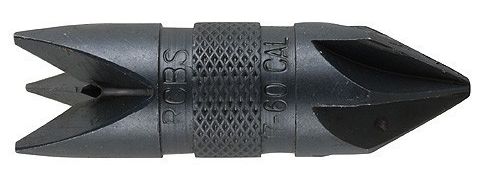
When I had seated about 50 of these, I noticed that compared to the bare projos the tips looked a little pinched in on the hollow point.
I know seating die inserts sometimes don’t play well with hollow point projos. I also double checked the OAL and it was correct. I’m thinking the load is compressed.
Then I looked at the current jacketed load data for Accurate #7 and the Hornady XTP isn’t even listed now which makes me more paranoid. The max load is well under 7.2gr and the OAL is also longer.
This has me extremely puzzled and frustrated. I backed down the charge to 6.5gr which works great with Hornady 147gr FMJ RN BT by the way.
I started seating and got down to 1.11". Everything looked fine. Then a gradual bump to 1.10" and now I see signs of the tip being pinched by the seater die. Weird.
AA#7 5.0 750 5.7 850 6.3 950 6.7 1,000
OAL of 147gr FMJ-RN-BT 1.165"
OAL of 147gr XTP-HP 1.100"
I know this has to be a combination of compression and the cone in my Lee seater plug being misshaped for anything but FMJ. A custom seater plug or longer OAL would be my only option with this powder.
I don’t understand why they are loading this to such a short OAL and not others. Or why the load data doesn’t denote a compressed load.
My Hornady dies came with two seating stems. One is cupped for FMJ’s and the other is flat for HP’s. Perhaps Lee sells a flat one?
As far as the OAL goes, just don’t go below what’s listed in the manual. You can always load longer provided you keep to a length that’s short enough to function in your magazine and will not cause the bullets to stick in the lands of the barrel. Generally, but not always, if you load to the maximum length that your magazine will allow for reliable function (cartridges not getting stuck in the magazine), then you’re good to go. I do that first, load up a couple of mags and then use my fingers to strip the cartridges from the magazines. If they seem good to go, then I remove the barrel from my pistol plop a cartridge in with the muzzle facing down and then flip the barrel to where the muzzle is facing up. The cartridge should fall out. If it doesn’t, the bullet is likely sticking in the rifling. It could also be that the case is not sized down enough for the chamber or the case is too long for the chamber. Repeat this test using several cartridges. If all work fine, you’re good to go. If not, then bump the length down a bit and try again. Longer is better because it reduces the angle that the cartridge takes to feed in to the chamber.
In regard to powder, I generally like to use fast powders with heavy bullets because the combination results in low felt recoil.
Also, avoid compressed loads in semiauto pistol cartridges. There’s often not enough tension between the bullet and case. The result is that the cartridges will slowly grow in length as the powder tries to uncompress itself.
Also, does the bullet you’re using have a rebated base like the one shown below?
If so, you do not need to bell the cases because the bullets will go straight in without the cases being belled. You also don’t need to taper crimp the finished cartridges because you didn’t bell the cases. Remember, the purpose of taper crimping is simply to remove the remaining bell that’s left at the case mouth. It’s not to help hold the bullet in place.
IIRC Lee states you can send them a projo and they will make you a custom plug to fit. I’m not aware of Lee selling one. I’ve just been loading a few hundredths longer and they easily seat, fit in my mags and feed well. I don’t notice much recoil difference between AA#7 and Titegroup for example.
Yes, the projo is boat tailed but I disagree with not having to bell the case mouth. I had heard that no bell is needed but found the resized case mouth often shaved off copper from the outside of the projo and didn’t seat smoothly. I just go ahead and put a light bell on all cases.
I’ve loaded tons of rebated base 9mm 147gr FMJ’s and have not had that problem. However, you might try chamfering the inside of the case mouths using a tool like this one.
It would surely eliminate the problem and would only have to be done once on each case so that subsequent reloadings wouldn’t require the step. Lee made the one that I’ve had for years and it works great.
The XTP has a very thin jacket and pure lead core. It will swage into a seater stem if the seating pressure is too great. One way to prevent to this is to use a flat instead of a conical seater stem. Another way is to use softer brass. Some 9mm brass, especially the military stuff, is very hard. It is hard to seat bullets without deforming the nose.
Second, the reason Hornady uses such a short OAL is because the nose of the XTP is a truncated cone. TC bullets are seated deeper than tangent ogjive bullets. If you seat them longer you may not be able to chamber the round in some guns, like CZ.
Finally, the data for these differs because the testing platforms are different and the components other than the bullet are different. A pistol with a generous chamber will take more powder before exhibiting pressure signs than a pistol with a tight minimum SAAMI spec chamber. Also, many 9mm barrels have .358" barrels where as SAAMI calls for .355". A .358" barrel with a machinegun chamber will max out a lot higher than a match barrel made to minimum specs.
However, chamfering the inside edge of a case for a semi-auto can have an adverse effect on a taper crimp. That inside edge you’re buzzing off is what prevents bullet setback when taper crimped. This makes it easier for a bullet to jump the taper crimp, and get set back into the case. This of course would make your chamber pressures skyrocket, as the gun rags are wont to say.
I’m already at my press so I just go ahead and bell all of them instead of having to keep a separate batch to the side to have to chamfer. Then if I change my mind I can always use the cases with any other projo. I don’t overcomplicate my process.
I’m going to have to respectfully disagree. A taper crimp does not help hold the bullet nor does it prevent setback. The term “taper crimp” is actually a misnomer created because some people incorrectly think of it as having a similar function to a roll crimp. A more accurately descriptive term than taper crimp would be “debelling”. The only purpose of a taper crimp (for a straight walled semiauto cartridge) is to remove the bell that remains after bullet seating. Anything beyond removing the bell is simply smashing the completed cartridge. If someone thinks they need to use a taper crimp to hold a bullet in place, then they simply don’t have enough tension between the case and bullet. The case simply needs to be sized down more. If you don’t need to bell a case to seat the bullet then you don’t need to taper crimp because there is no bell to remove (just like when you seat a boat tail bullet in a bottle necked rifle case). The amount of tension created due to contact between the inside edge of the case mouth and the bullet is inconsequential, so chamfering the inside of the case mouth will cause no problem at all. I have lightly chamfered the inside edge of thousands upon thousands of case mouths and have never once had a bullet setback. Before I taper crimp (debell) I perform a push test on several cartridges to make sure I already have enough tension between the bullet and case to prevent setback. Hope this helps.
J-cat, I honestly have to say that I’m confused by your response. “Case tension prevents bullet setback, not taper crimp” was basically the point of my post. I also don’t get the “disrespectfully” thing.
It didn’t take long. You wrote “I disrespectfully agree”, but my mind read “I disrespectfully disagree”. Yesterday was kind of a long day. I must have used up all my brain power at work. I’ll have to try avoiding that.
Rolling the inside edge of the case slightly into the bullet was designed from the start to prevent, or at least reduce bullet setback. It is exactly opposite from the function of a roll crimp, which was developed to prevent inertia from causing bullets to “pull” themselves forward, out of revolver cases, which would tie up the gun. Case neck tension does hold a bullet in place, but can be overcome by the bullets physically contacting the gun during the feeding cycle. It doesn’t take much of a taper crimp to reduce the possibility of bullet setback, and too much of a taper crimp can swage the bullet down slightly in diameter.
And thanks for the disrespectful part. I thought we were supposed to be adults here, but I see I was disrespectfully respectful by trying to explain something I’ve learned along the way. I see RCBS has it all wrong too. This is from their catalog, the dummies.