Lesser Known AR-15/M16 History

One of the best books on the early history and development of the AR15/M16 is “The Black Rifle – M16 Retrospective,” by R. Blake Stevens and Edward C. Ezell. In my opinion, it is a ‘must read’ for any student of the AR15/M16. In the last paragraph of the foreword Stevens states:

“Outrageous untruths become more like “gospel” with each retelling in this atmosphere of misinformation, to the point where the true story of the Black Rifle, as it emerges for the first time in these pages, will quite likely surprise most readers.” (1)

Unfortunately, untruths alone are not all that spread misinformation. A biased author (or authors, in this case) can, and do, create a distorted picture of history. So, while they might claim that their book contains no untruths, it does just as bad an evil by slanting the facts so that the reader walks away with an incorrect view of things.

The first and major problem is one I have seen in many “history” books, and that is the perceived need to “tell a story,” rather than “present history”. Stories have heroes and villains, conflict, rising action, a climax, and the denouement; history rarely has these elements. History authors prefer to tell stories, because stories are more interesting and engaging, you get to cheer for the plucky under-dog hero who pits his invention against the evil, uncaring, bureaucratic, monster, and we can celebrate when he wins. In reality, history is rarely a story, but that does not mean it cannot be interesting.

One of the big things this book tries to hammer into your head is that the Army, specifically the Ordnance Department, and super-specifically, Dr Fredrick H. Carten did not want the AR-15, and continually tried to torpedo the program. This sets up who the evil villains are, and you can guess who the hero is are going to be. Now, aside from the simple fact that the Ordnance Department is not who decides what weapons the Infantry gets, that is the purview of the Infantry Board, the Ordnance Department, and Army in general, was very receptive to the AR-15, and the .22 caliber bullet, as a combat weapon.

For brevity sake I am not going to relate all the research funded by the Ordnance Department and the Infantry Board on .22 caliber and other Small Caliber High Velocity (SCHV) weapons, and skip to a single report that shows what the prevailing view of .22 caliber weapons really was.

For those that may not know, the Lightweight Rifle Program was the project that tested the T44 (M14) against the T48 (FAL), and eventually lead to the M14 being formally adopted in 1957. The program started in 1952, and each summer and winter hundreds of thousands of rounds were expended testing the two prototypes, with the failures and deficiencies noted to be corrected for the next round of tests. While hideously expensive, the results were that by 1956, both the M14 and the FAL were probably the most reliable and durable rifles in the world. So, finally after seven rounds of testing over four years the final report on the T44/T48 competition was published. So, which one was recommended for adoption? I will quote the report:

“3. It is recommended that:

a. Neither the T44 nor the T48 type rifle be adopted for Army use.

b. A truly lightweight rifle system wherein all or most shoulder fired Weapons are replaced by a single weapon with light and heavy barrel versions (if required) remain as a development objective.

c. A lightweight ultrahigh velocity small caliber rifle be developed on the following time schedule:” (2)

It then goes on to outline a recommended detailed development schedule, of which I will only note three milestone dates, June 1957 - cartridge development, July 1957 – Industry-wide rifle development competition, July 1958 – engineer/user competitive tests.

The Infantry School goes even further with their comments:

"This phase of the rifle development program, directed toward the attainment of a lightweight rifle system, has produced rifle systems that closely meet the previously established military characteristics; however, these rifle systems do not meet the requirements for a lightweight rifle during the latter part of the 1960-70 period as established in the Combat Developments Objective Guide, dated 1 May 1956. Further, it is believed that the T44 and T48 (FN) rifles offer no more than marginal improvement over the present system in range, accuracy, lethality, ballistics and weightwise, except in the case of the BAR which is approximately six pounds heavier than either the T44 or T48 HB variants. Consequently, in view of the Army’s stated policy to refrain from mere product improvement, and the inability of our program as yet to produce a truly lightweight rifle with an increased casualty producing capability. The infantry School recommends that:

"a. The T44 rifle system be considered an ‘on-the-shelf’ item for national emergency production in the event its use is required prior to development of an optimum ‘individual weapon,’ and that concentrated developmental effort (funds and technical skill) be directed toward the expeditious attainment of the optimum individual weapon of radical or advance design.

“b. If due to standardization commitments [sic], it is considered imperative to adopt a lightweight rifle system at this time, the T44 rifle system be adopted, and development effort be continued toward the attainment of the optimum Individual weapon of radical or advance design.” (2)

The Secretary of the Army, and the Ordnance Department took these recommendations to heart. A new rifle was required, as the M1 Garand was definitely long in the tooth and its limitations by this time, increasingly apparent. Standardization issues were also considered imperative, as by 1956, the 7.62mm NATO cartridge had been standardized for two years, but no U.S weapon was fielded in this caliber, while both Canada and the U.K. had adopted the FAL and began working on converting BRENs and M1919s. Even the Germans were ordering G-1 rifles in 7.62mm NATO. In 1957 both the M14 and M60, both in 7.62mm NATO, were standardized by the U.S… What also happened in that year was the U.S. Army Infantry Board finalized the Military Characteristics Requirements for a Small Caliber High Velocity (SCHV) Rifle and associated ammunition, Springfield Armory contracted Remington Arms to produce a .224 caliber cartridge based on a lengthened .222 Remington case (this cartridge was initially labeled .224 Springfield, later marketed by Remington as “.222 Magnum”), and later that year, Armalite would order from Remington some .222 Special ammunition of Stoner’s design.

In the middle of 1958 competitive tests of the Armalite AR-15, Winchester’s .224 “Lightweight Military Rifle”, and the T44/M14 were held at both Aberdeen Proving Grounds and at Fort Benning. From these tests the Armalite design was judged superior in many aspects, and in need of further development in other areas, but generally a positive review.

Right on schedule with what was proposed by CONARC in 1956. However, with the M14 entering production more engineering and monetary resources were needed with that program, the SCHV was placed on hold, besides its intended fielding date was the around 1970, so it was not and urgent program. And, who knew if maybe the .17 caliber flechette thing, or SALVO would prove superior. Since the AR-15 was the property of a commercial vendor (it had just been sold to Colt’s), and they had the list of deficiencies and shortcomings revealed in testing, the Army was not required to be involved with further development at this time.

Being on the back-burner is very different from being unwanted.


  1. “The Black Rifle, M16 Retrospective” R. Blake Stevens and Edward C. Ezell, Collector Grade Publications, Ontario, 1994

  2. “Service Test of Lightweight Rifles,” Headquarters, Continental Army Command, Ft Monroe, Virginia, 20 June 1956)

GOV weapon testing is not biased, it is straight out crooked from everything I’ve seen and first from first hand sources.

I’ll repeat a comment that I heard, which I thought was 100% correct and put things in perspective. If we skipped buying secretaries new computers for ONE year, we would have funding for new weapons across the board. No, I don’t believe that included ammo, and perhaps not extra parts (or maybe it did include parts), but it shows the POV for where importance lays.

The services should be all using the same weapon. The IAR/ M27/ HK gun should never have been issued to the USMC. It should have been denied. Don’t get me wrong, additional weapons should be allowed on an as needed basis, for example, Delta wants new 416s? Buy them. They should have whatever they want. Supply troops want new weapons? Buy them scanners so they can do their actual jobs correctly. The money/ funding should be used appropriately.

All of us serving or having served are familiar with the terms “fraud, waste and abuse”. Uniforms should be the same, weapons should be the same, boots should be the same options, and the list goes on and on. Too much money is wasted that doesn’t need to be.

Why does the Army fly Apaches and the USMC flies a Super Cobra and Viper variants? Two completely different airframes for the same mission. The list goes on and on, but the Joint Chiefs could straighten it out in an afternoon if they cared. We don’t need classes on affirmative action/ race relations. We don’t need classes on how to not rape people. We don’t need the endless BS to make people feel good. Take those classes and trade them for combat related taskings, and make everyone go through them.

Hell, show me a routine unit that has everyone currently qualified on all their weapons (who isn’t gearing up for deployment) and I’ll be impressed.

[QUOTE=lysander;3136813][/QUOTE]

Sorry for the rant, if its too far off topic I can delete it. Weapons procurement is a massive pet peeve of mine. They are beyond dirty. Things like weapon testing the AR15 in the Artic and doing it with FSB pins removed, then pounding in welding rod for when it is set back after testing is complete is just one example I’m aware of (I later fired that same weapon with that rod still in place decades later).

At the risk of taking a tangent, Stick, my understanding re Apache vs Cobra is that the Cobra is more conducive to maritime/amphib/shipboard ops than the Apache–they both kill bad guys and blow up their shit, but a lot of it goes back to operational differences like the luxury of a spread out land base vs the tight quarters of a ship, or the Cobra being more easy to beat back into shape with lower-level tools–llike A-10 vs F-16 in CAS.

Objectively, in the battlefield the Apache is the better weapons system; operationally the difference is in the forward-deployment basing getting TO the battlefield and going home after.

At least, that’s as I understand it from a lifetime around aircraft and the aviation industry, I probably don’t have the entire picture. Then again, give me a blank-check budget to build any helo I want and I’m building the AH-53 “Super Stallion rebuilt into a Hind from Hell” that a buddy who was an engineer at Sikorsky and I cooked up… imagine a VTOL Hog that can both lift the troops into battle then immediately pivot right into their topcover.

Deleted, would take things way too far off course.

I have BR 2 inbound. The first issue is currently out of print and at a rape price from people who will take stupid money for their copy.

Stick, rather than just delete that might be better to start a new thread of its own–we got plenty of wingnuts here that might not see this thread but be interested in pitching their own relevant thoughts. :slight_smile:

Stick, I took the Wingnuttery/Single Point of Failure vs Redundancy discussion over here.
https://www.m4carbine.net/showthread.php?242687-quot-Parallel-Systems-quot-split-from-Lysander-s-quot-Leser-Known-History-quot-thread&p=3136849#post3136849

Steyr

Those four books on the lower left…the two AK ones and two AR ones. Who were the authors/publishers of those? They don’t look like the “Collector” series from Stevens/Ezell (AR part I and II, the FAL, and the M-14).

EDIT: never mind, I see they are Vickers’ books from blowing up your pic.

The really interesting ones are the two Blue Ezells’ to the right of The Grim Reaper. And yeah, Vicker’s Guides are awesome.

I’ve got the two AR books, they are nice. I would like to score the AK books sometime.

Let’s look at that incident for a minute, since it is so often cast as “the Army trying to shut down the AR-15” . . . .

The report that details that test is, “Report of Project Nr 2787 (Arctic), Evaluation of Small Caliber High Velocity Rifles,” U.S. Army Arctic Test Board, U.S. CONARC, Fort Greely, Alaska, 17 April 1959.

First off, no manuals, special tools, or spare parts were sent with either the AR-15 or the Winchester Lightweight Military Rifle (WLMR), and before you start trying to blame the Army for not sending stuff, the shipping was from the manufacture’s facility as modifications suggested in the temperate test were to be applied, if possible. One of the standard tests done by CONARC all through the T44/T48 series was a field strip and a detail strip in arctic conditions. All previous tested rifles either could be disassembled to a barreled receiver and a pile of loose parts, or had maintenance instructions providing guidance on what were intended to be permanent assemblies. In the particular case of the AR-15s sent to Alaska in 1958 was they were the first prototype (see Figure 1 below). With this version of the AR-15, you cannot remove the handguards without removing the front sight. So the front sight pins had to come out.

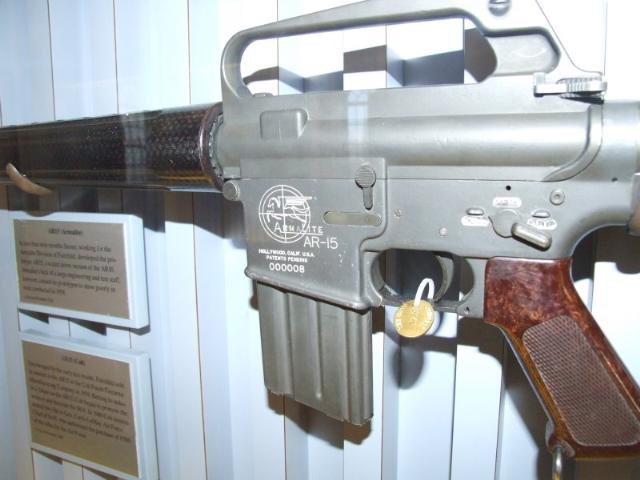
So, the first test was four testers would perform a field strip and assembly three times while wearing the M1951 trigger finger mittens over the knit wool mitten liner. Then this was repeated with the testers wearing Type 1 Arctic Mittens with the wool knit inserts. Then the four testers would detail strip a rifle three times in both kinds of mittens. So those three rifles, serial numbers 000007, 000008, and 000009, were taken apart and put back together quite a few times.

No difficulties were reported, other than difficulty picking up small parts like the extractor pin and the firing pin retaining pin. The only special tool required was a punch and ball peen hammer. No parts were lost and only a safety broke during the test.

During Test Number 10 - The reliability test where the rifle was fired at 250 rounds per hour, for four hours per day, over a four week period (or until unserviceable), four of the front sight taper pins became loose and were lost, when they fell out is not in the report. This caused the gas tube to separate and the rifle became inoperative. With no spare parts available, substitute parts (the infamous welding rod bits) were installed and firing continued.

So, the pin becoming lost happened after all of the accuracy tests were complete, and had no impact on the known distance firing (Test Nr 4), transition firing (Test Nr 5), combat firing (Test Nr 6), adverse condition testing (Test Nr 7), feed system test (Test Nr 8), and sight tests (Test Nr 9). During the reliability the two rifles, S/N 000007 and 000008, displayed keyholing at 9,137 and 10,094 rounds, and a total 9,188 and 10,169 rounds respectively. Pretty good for a barrel on required to last 5,000 rounds.

SO

The front sight taper pins being lost had no impact on the test results, which were generally positive, despite Mr. Stoner’s recollections years later, during the Ichord testimony and even later interviews.

This is one of those myths that just will not die. And worse than not dying, it get embellished with every re-telling . . .

Prototype AR-15, S/N 000007 - Currently at the United States Army Ordnance Training and Heritage Center at Fort Lee, Virginia
Prototype AR-15, S/N 000008 - On display at Springfield Armory Museum, Springfield MA
Prototype AR-15, S/N 000009 - Location unknown

Figure 1. Prototype AR-15 S/N unk

Figure 2. S/N 000008, image courtesy https://www.flickr.com/photos/57847011@N07/35012494266/in/photostream/

Figure 3. S/N 000008, image courtesy of Springfield Armory National Historic Site webpage

Thank You!! Always grateful for your knowledge.

The authors of “The Black Rifle” tell you that they only tell the truth, but unfortunately, that is not true . . .

Let’s look at page 71:

[i]"The Curiously Missing Results of the First Aberdeen AR-15 Trial -

. . . Bill Davis recalls having first seen an AR-15 when specimens from the first 17 rifles were sent to Aberdeen for the mentioned 1958 engineering trials. A description of these tests constituted the elusive Fifty-Seventh Report on Ordnance Project TS2-2015 of February 1959, entitled A Test of Rifle, Caliber .22, AR-15; Rifle, Lightweight Military, Caliber .224 [Winchester]; and Pertinent Ammunition, by Laurence F. Moore. . . . when these critical recommendations and conclusions extended to the basic design as well as the performance of Ordnance-sponsored weapons, which they very often did, Moore’s uncompromising attitude was not so well appreciated in the Pentagon offices of the Ordnance Corps.

With this in mind it is interesting to note that the published version of Larry Moore’s Aberdeen report on the AR-15 and Winchester .224, as well as two. further trials discussed in chapter 4, contain none of the usual recommendations or conclusions."[/i]

First off, this is hardly an “elusive” report, but you do actually have to ask for it at the Defense Technical Information Center, Accession Number: AD0211240, and give them a good reason you want to read it.

This part, “With this in mind it is interesting to note that the published version of Larry Moore’s Aberdeen report on the AR-15 and Winchester .224, as well as two further trials discussed in chapter 4*, contain none of the usual recommendations or conclusions,” is just flat wrong.

“Section 4. CONCLUSIONS,” starts four lines into page 71, and is three short paragraphs, “Section 5. Recommendations,” follows immediately and ends on the signature and approval page.

If the report was truncated as we are told it was the Observation Section would end in the middle of a sentence, and there would be no signature or approvals. Also, page numbering would jump from page 70 to 73. No the report was published in its entirety, and anybody that read all the way through would get all the information the author intended.

Then Mr. Bill Davis is quoted as saying on pg 73, this: "… Our recommendation was that development of the AR-15 proceed, under Army sponsorship . . . "

He may have thought he said that, but he did not. What he wrote was:

[i]"It is recommended that further development be conducted on the caliber .22 rifles and ammunition to correct deficiencies observed in this test and, when this is accomplished, the material be again subjected to a standard engineering test.

AR15 Rifle

The barrel be replaced with one of heavier design.
The magazine be redesigned by decreasing the length to give a capacity of twenty rounds.
The automatic fire feature be eliminated.
The sights improved by replacing the metallic sights with a low power telescopic sight or by installing a rigid front sight at the muzzle and a rear sight, adjustable for both elevation and windage on the receiver.
The hand guard be redesigned to improve its heat insulation characteristics.
Roll pins be replaced with a type which gives better endurance and disassembly characteristics."[/i]

No mention of the Army taking over from Armalite. And, if those are not his desired recommendations, then why is his signature right below them, not once, but twice as both the Branch Chief and the Division Chief?

  • The other report is “No. DPS 101 A Test of Rifle, AR-15” of November 1960, also by Larry Moore, and is exactly what he asked for in the earlier report. Colt got the rights to the AR-15 and fixed some stuff and returned it for testing. Read it for yourself and see that the reason this report has no recommendations is because the author did not write any.

The Marine Corps wants two engines for greater overwater safety and increased payload. Their Hueys also had twin engines.

Unsure about the Cobra and the Hueys, but to my knowledge most other USMC and Navy helicopters have rotor brakes.

The Viper and the Venom (UH-1Y) also have four rotors.

Short answer is landing surface. The Cobra’s and Huey’s have a much smaller landing space which makes them more ideal for ship to ship and ship to shore operations, the second is overall operational cost, the cost of maintaining a Blackhawk type Helicopter on the bottom end is $3000 per flight hour verse $1600 per flight hour for a UH1Y, this is also data from when I was in from 2011 so it’s dated but not necessarily changed in the ratio of dollars per flight hour.

Hello Stick, not the same mission profiles in a lot of way’s while at the same time they overlap quite a bit. Comparing the Apache to the Cobra is like saying the Mk12 and the Mk18 do the same job. The Apache is and has always been a hunter killer of tanks and entrenched units, to be on the battle field for a prolonged period of time, while the AH-1z Cobra is a designed to offer close air support but furthermore to clear paths and harass enemy units while mobile forces move into place. You’re looking at it from the McNamara perspective vs the individual needs perspective

Very interesting thread and history we never hear of.

Also–if you guys want to talk helicopters—start a thread in General

Mark, I already started one in Stick’s section and linked it above… and it promptly got hijacked. :frowning: As a mod, could you maybe do a Cut-N-Splice moving posts over?

Another method the authors of “The Black Rifle” steer the reader to their biased view, is to not present all the facts.

If we look at page 54 in Chapter Three, we are given a quote by Mr Bill Davis:
. . . Accordingly, we had drafted a letter to [the Office, Chief of Ordnance] some time in 1955, proposing a .22-caliber cartridge, employing a boattail bullet of approximately 55 grains weight, at a muzzle velocity of approximately 3,300 fps, for use in a rifle substantially lighter than the T44/M14. We had also proposed a program to design such a cartridge at Aberdeen, build one experimental automatic “test fixture” (rifle) to fire it, and requested one-year funding authorization in amount $60,000 for this project. . .

Then Makes the bold proclamation:

“DR. CARTEN’S FIRST DENIAL”!

And then the authors go on to say that Dr. Carten hated the SCHV Program AR-15 and wanted to kill the program from the get-go, and the first step was to kill Davis’ request.

This assertion does not hold up to the facts.

First, the testing activity (Aberdeen, where Davis worked) is not supposed to develop stuff, as it will have to test it. Having the inventors do the testing leads to bias. The best policy is to have an independent tester. So Carten was right to deny the request.

And, from Davis perspective it must have been disappointing, but what he did not see was happening elsewhere in the Army. In December 1955, Davis published “An Investigation of an Experimental Caliber .22 High Velocity Bullet for Rifles”. This was the final report on the Aberdeen SCHV project that Davis had been working on since 1953. What this report basically says is: “This little .22 caliber bullet we have been working on seems to be pretty lethal. It’s time to really start developing it into a militarily useful product.”

According to the authors, Carten can have this, so he denies funding to Davis, and sits on the report.

OR, DOES HE?

This all happened in the fall and winter of 1955, at the time Davis was getting his disappointing news about his project, The Midwest Research Institute was being awarded a contract to look into, among other things, a .22 caliber high rate of fire weapon. In February 1956, only two months later, Winchester got a contract to develop a .22 caliber duplex weapon, that would use the cartridges designed by Davis. A few months later, Winchester begins work on their Lightweight Military Rifle (WMLR), and its associated ammunition, as would Stoner at Armalite start the the work to convert the AR-10 to AR-15 in .222 Remington, after suggestions from the Army that such a weapon would be of interest to them.

Dr Carten had been the chief civilian in the Ordnance Department since around 1952, if he hated the idea of a .22 caliber military rifle, why did he authorize money and manpower to develop such a cartridge in 1953? Why did he continue to fund it up until 1956? Why did he contract out development of .22 caliber weapons in 1956 and 1957? Why did he direct Springfield Armory for develop a .22 caliber cartridge in 1957?

The truth is Carten did not try and kill the .22 caliber cartridge idea, nobody in the Army did (at least in a serious manner). But to “make a story”, you need a villain, and Dr. Carten got drafted for that job.