Question; is there a buffer low weight minimum, not to pass or go below?
I guess if positive cycle rate performance incurs carrier bounce its time to open the port?
I’m currently at 2.6oz buffer (using Strikes’ Optima Buffer kit for weight mgnt.) Started with 3.28oz, then 3.03oz.
My brass (M855 DRZ penetrators, 556 62g, and some Armscor 223 rem 55g) ejecta have gone from 5 – 530 up to about 330 o’clock and from not cycling new rounds to consistent feeding, with Brass, but Steel (Tula 55g) is still not auto feeding.
I know this forum is M4Carbine.com, but I’m looking for as many “experts” as possible for help with cycle rates on a 20” piston build. Using a Adams Arms rifle length kit on a Faxon, it is so far been performing under gassed. I read through the STICKYs here re short stroking and Buffers…all great reads and confirming science/known engineering. Rather than go straight to opening the port, Im playing with the other end of tuning.
The port on the 20″ Faxon, 556 I have is 0.078. I confirmed with Adams Arms responded that their rifle kit should operate with a 0.098 port. So I know Im under-gassed. Machining and drilling holes is pretty straight fwd but not reversible. I might want to use the barrel for a DI rig eventually if this piston party flops.
Considering the timing to pressure on the bcg is a lot different on pistons, I will re-evaluate going lighter rather than heavier. I started with a standard, 32 coil springs and 3.06oz buffer and full open adjustable block. The performance progress trajectory I’ve gained going to a lighter buffer spring and weight show positive feed back.
I will also look into the bolt lock test, but I’d have to switch lowers. This rig is a Commiefornia special running a Juggernaut Tactical kit….these replace standard bolt catch for a mag lock and release.
Tula is known to be…sensitive. Bolt bounce is more of a thing for auto, not really a problem in semi. With a DI gun, you can go down to a completely empty buffer, safely, if the gas is choked down enough, but it will be more sensitive to changes in ammo and whatnot. I don’t know whether that’s a good idea or not with a piston.
Tula is the lowest common denominator. It is known for being rather lame in .223 or 5.56 rifles. Get your weapon to function with “normal” ammunition, unless Tula is to be the main fodder used. Not dogging on your ammo choice but I don’t shoot steel-cased stuff unless it’s through an AK, because that is what it’s made for.
I feel like a lot of the add on piston kits are over gassed. I have not done cyclic rate testing or tried any on a barrel with a reduced port size… But, they generally claim to work on a wide variety of barrel lengths and even different calibers as long as it’s the right gas system length.
They gave you the normal 20” DI port size. You can open the port up probably half way to that and stop playing with buffers, without worrying about it being too big for DI.
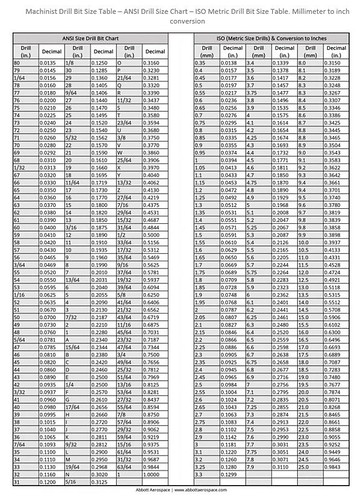
yeah the port may be the ultimate bottleneck. I figure use the buffer tuning first, cause I got the dynamic kit and preserve the barrel. if I get to zero buffer weight, 0.99oz empty, then I’ll be forced to get more gas. Currently I’m not satisfied with the fractional bit sizes available at the hardware store. waiting to find a good machinist bit set with very small increments.
HD has pretty hard Cobalt and titanium bits that will definitely cut barrel steel. Regardless, for me the standard fractional increments are too big and dont let me land on most precise gas as possible.
From 5/64; 0.0781in to 3/32; 0.0937in is 19.9% increase
0.0156 ÷ 0.0781 = 0.1997
From 3/32; 0.0937in to 7/64;0.1093in is 16.6 % increase
0.0156 ÷ 0.0937 = 0.1664
The ANSI Drill bit size increases in increments of 2-3%. My target size per Adams Arms is 0.0980, which from the Faxon barrel starting with a 0.078 port, this is a jump of 25% increase in gas. Going with the 7/64 bit would add another 12% extra gas