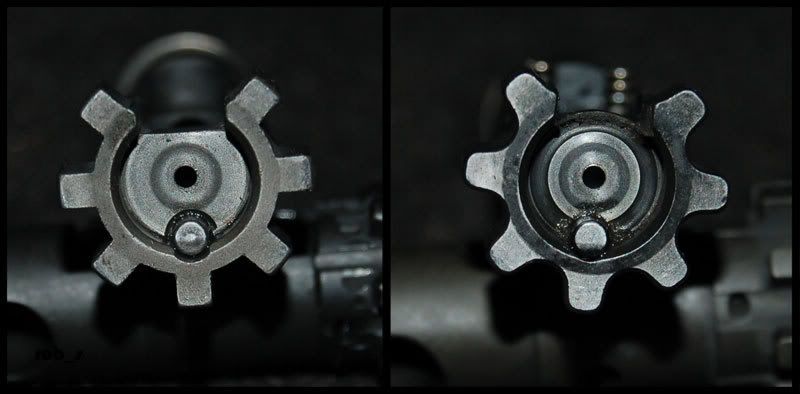
For the units that were shooting a lot of suppressed carbines, I think they were experiencing more early bolt and extractor failure due to higher cyclic rates and the shear forces of early unlocking on those components.
LMT actually had a great solution for this with the enhanced BCG, where the cam path was elongated like HK did to the AR18 when they made the G36, and one of the AerMet alloys was used for the bolt to increase strength of the tiny lugs and limited lug root, as well as cam pin hole walls.
https://www.m4carbine.net/showthread.php?3379-LMT-Enhanced-Bolt-Question&p=62128#post62128
I was talking with one of the Colt Canada (formerly Diemaco) engineers about all this, and he said they took high-speed camera video of the action comparing suppressed Stoner Internal Expansion and HK416 Op-Rod driven guns, and the regular Stoner gas system was more suppressor friendly as it unlocked later. The 416 immediately begins carrier movement because the gas hits the piston head, which instantaneously starts a rapid movement of the carrier.

On the standard Stoner gas system, there is a bit of a delay, because the gas has to pressure up the tube and expansion chamber inside the carrier to get enough BCG inertia for extraction and ejection.
My suspicion is that the units using the HK416 prefer it suppressed because the bolt is made from a superior alloy, and lasts longer in their high volume sessions. The carbon deposits are also moved to the front of the gun at the gas block and plug, rather than inside of the carrier and upper receiver.
Either way, I think 2 main approaches are more important than the method of operation for the action:
- Flow-through suppressors that don’t significantly increase cyclic rate
- Increased strength bolts
The big Army didn’t allow SOCOM to adopt the LMT Enhanced BCG upgrade for the M4A1 PIP because if those BCGs ended up in a RLGS M16, they would short-stroke the guns, so SOCOM responded by initiating an independent program to find their own carbines, hence the SCAR.
Another great solution for the AR15 bolt strength when suppressed is the KAC SR15E3 system, which has more lug root strength for both the bolt and the extension, and more cam pin hole wall thickness by using a smaller diameter cam pin.