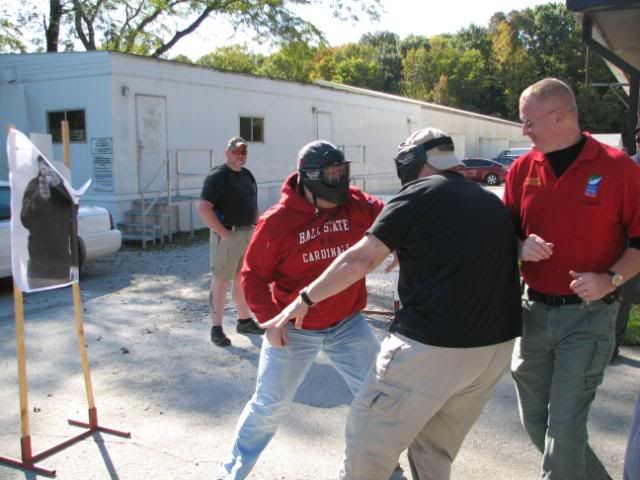
First this a snap shot in time, a very small glimpse at one force on force scenario.
The student in black started out with his protectee (guy in red behind him, picture your wife or kid) on his reaction side walking down the street, so far so good.
He is then confronted as he turns the corner by a man with a knife ordering him to give up his wallet. Our good guy uses his reaction side arm to move his protectee behind him but due to the dynamics to the situation the protectee is now moved to the good guys strong side. This causes three things-
His first instinct is to now get his right hand up to reestablish physical control of his protectee, this becomes exaggerated now because instead of being off to his reaction side his protectee is behind him causing him to stumble backwards. As he falls to the rear both hands come out to the side. His right arm also seems to be pinned against his body hampering a possible draw. This is when you will need open hand skills. The bad guy already spooked advances with the knife.
This did not end well for the good guy.
There is no perfect answer to any of this, I post it to show how with step this way or that way the dynamics of a situation can change dramatically.
Tough escalation scenario for the untrained combatant. Simplest response of course would be to draw your weapon as you move the protectee back. At this phase, were I to get into that scenario, I would have to resort to hand to hand, trap the attacker’s weapon hand, take out the lead knee, and push them into ground submission. Of course, how often would one face a left-hand attack that would force such movement reaction? A skilled adversary could use their non-dominant hand in such a way, but how many trained attacker’s would one be likely to encounter?
As mercop said, this is where body weapon proficiency comes into play instead of relying on getting to the tool to counter a tool.
Looks like the “defender” did well getting the principle away from the AOA but failed to dynamically use his inseam in the process to completely move the principle and orientate his base towards the threat where he could efficiently deliver strikes to target areas available , proceeding through him and rendering him ineffective then moving on to any accomplices that may be present.
The “offenders” blade is still below his waist band and he is not guarding any of his target areas. If the “defenders” arm wasnt sucked against the principle it could have been used as an effective stiking medium while the left arm could have been used as a “checking” medium.
Just what I gather from the pic.
Thanks for posting it and arousing a good baseline for great discussion