Acceptable accuracy

Colonel Cooper had a saying about the irrelevance of these accuracy increments. Can’t remember it offhand.

I think the question is: Can you get it out of your holster and consistently make a combat-effective headshot at 25 yards if you have to? I know Glock, HK and Smith can do this, even in the subcompacts.

I’m having a hard time envisioning when it would be important to put three to five shots in a 2-inch group at 25 yards.

In a sense of practical application - yes, it unlikely to be ever important. It is just a measure of fundamental skills; taking target out to 25 simply makes errors more apparent.

I’d hazard a guess that one has no chance to make a combat-effective head shot out of holster at 25 if he is incapable of printing a reasonably small group at same distance under ideal circumstances. So, to return to practical applicability, a slow shooting for groups is a “walk” part of “crawl-walk-run” progression to me.

Damn, i knew i was not in the same league as the better pistol shooters, but some of you guys are really making me feel ridiculous. 2" at 25yds, not 25 feet…yards?

Hell, 4", 6", at those distance, to me that’s still excellent shooting in my mind. I need more practice! :frowning:

As I said above, consistent sub 5.5 inch groups would be a big milestone for me.

Totally from a bench/rest! :wink: Hell from a ransom rest if they were plentiful and cheap although I’ve heard poly guns are tough to ransom.

However the OP question is about the gun - not the shooter. And no matter how many folks say - and this includes Jeff Cooper - that 2" or 5" capable guns - no real world difference - they are wrong. Doesn’t matter their pedigree. Good shooters shoot better with more precise pistols than with guns that can’t group better than 5-6" - like several of the rack grade 1911s I’ve owned or my M&P Pro 9.

The best shooters - including those who shoot for blood - consistently spec their pistols for high levels of inherent accuracy. As our high speed SME’s here sometimes post “that’s a clue”.

ammo choice will make a difference in accuracy as well.

for example:

Factory Speer 9mm 124GD always grouped better than WWB 9mm in any 9mm I had.

I haven’t reloaded yet for 9mm but I suspect a reloader can equal the Speer accuracy with just a consistent powder charge. Then add in a quality bullet over a ‘mass production’ bullet and it will likely improve further.

Dan makes a good point, in addition, we have seen fairly wide variances in quality control from factory ammo the last few years. Factoring in just the ammo component makes it more difficult to assess the capability of the platform.

I’m in on this aswell.

My intention of this thread was to find out what was acceptable accuracy, off hand, with a poly frame pistol. I do believe, in my experience, that all metal/alloy framed pistols are more accurate for various reasons.

My interest in this issue is because I’ve heard many people say that the M&P 9mm has sub par accuracy. I know that there are many threads regarding this.

The question is at what point/distance and at what group size/inches makes a pistol not accurate enough?

To me it would be a mechanical accuracy of over 3 inches at 25 yards.

Polymer framed pistols can be quite accurate:


H&K P30 9mm, 5 shot group offhand at 25 yards. Note that 4 of the 5 shots form essentially one big hole. The hit in the 9 ring is a called flyer.

S&W M&P 9mm offhand at 25 yards. Note that 4 shots are in the X ring, and 4 shots are in the 9 ring because I sucked. The shots in the white are because I sucked really bad. The weapon itself was fully capable of putting all the shots at least in the 10 ring.
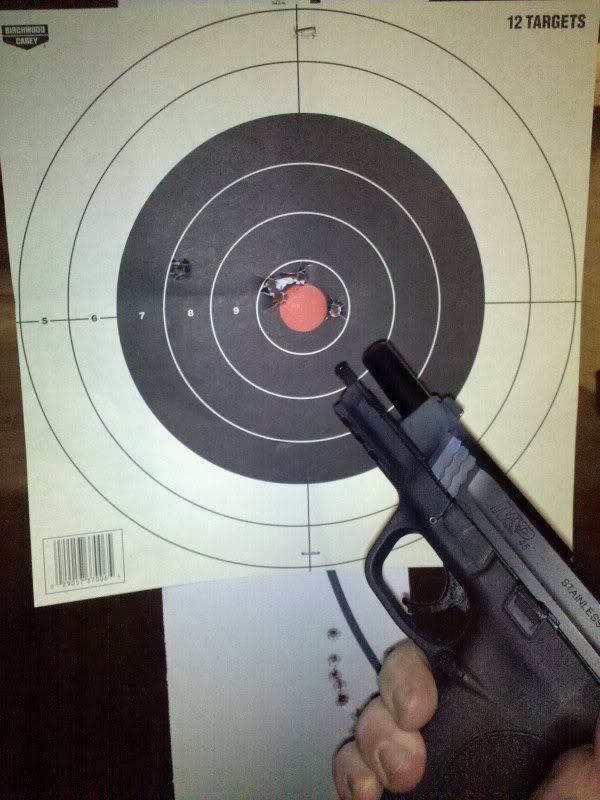

S&W M&P .45, 5 shot group at 25 yards. 4 shots are clustered very close together with the 5th a called flyer. (Called flyer means I called the shot’s location as I broke it because I screwed something up)

Polymer pistols can be very accurate as these specimens show. I’ve yet to shoot a decent polymer handgun (Glock, H&K, Sig, S&W M&P, Walther, etc) that had accuracy problems. All of them seem to have been fully capable of making a hit on a reasonably sized target at 25 yards if I did what was necessary on the trigger and the sights. In that chain I’m invariably the weak link.

In other words, when it comes to most pistols I don’t really worry too much about their inherent mechanical accuracy. Now it’s certainly nice to shoot pistols that are as accurate as the specimens I’ve put up in pictures, but even my humble Glock 17 is capable of far more accuracy than I can wring out of it. The last time I shot it my groups with the G17 on average were slightly smaller than what I normally get from my P30 at 25 yards…even though in the above picture you can see how accurate my P30 is.

In general if the weapon is mechanically capable of 4" groups at 25 yards (factoring out all shooter error…good luck trying to accomplish that, though) then it’s more than sufficient to any practical task you could ask of it. More mechanical accuracy isn’t ever going to hurt, but it’s not something you need to chase.

M&P’s seem to perform best in the accuracy department with light projectiles. The heaviest ammo I shoot is 124 grain +P Gold Dot, which my 9mm M&P’s (I own 4 of them) seem to like quite a bit. Heavier projectiles (like 147 grain) seem to be sub-optimal in the accuracy department. There are also 9mm M&P’s suffering from a premature unlocking problem which can manifest in groups that are insanely high at 25 yards or insanely big. Enough guns have had the problem for it to be a known concern, but in percentage terms the number of guns that are afflicted with the problem seems to be fairly small. I’ve bought 5 9mm M&P’s over a period of 3 years and all of them seem to be capable of good accuracy.

With all due respect to the deceased Colonel, he wasn’t Moses. There is never going to be a time when having the ability to place extremely precise fire on a target/threat is going to be a liability. Shots in the real world may not always be on a big target standing still at close range. In the Training forum there’s an account of a deputy who was shot multiple times by a guy with a rifle and he had to defend himself with a pistol. The bad guy was wearing body armor and the deputy, on the ground, had to shoot underneath the vehicle at whatever small targets of opportunity he could get his sights on.

It’s not absolutely critical to have a gun that shoots 1" groups at 25 yards…but if you can get a reliable, durable, affordable weapon that does manage to shoot 1" groups it would sure be a good asset.

I’ve used my P30 to hit more or less the center of a steel silhouette at over 130 yards with iron sights. I watched LAV with a G17 make the same hit. I watched CoolBreeze knock down 6" steel plates from roughly 100 yards with an open sighted Glock 19. As a general rule, the majority of service grade handguns on the market are more than sufficient in the accuracy department.

I once asked Vickers about accuracy, shooter and gun.

He felt, the shooter should be able to hit a standard bull, so 5.5", lets just call it 6" at 25 yards/mtrs offhand, on demand.

Therefore the gun should be capable of 1/2 that from a mechanical rest.

I agree with Alaska, the more accurate the gun the better, your just removing one variable from the equation. On the other hand, if a particular gun brings something else to the table, I’ll give up a bit of accuracy.

Bob

My deviation from the bullseye is mainly from my vision :o

Pat,

Just for reference, I am a steel frame pistol type and I prefer a 1911. However I do own numerous poly pistols. Having said that, I would agree that I could get more accuracy out of a custom fitted steel framed and steel slide pistol. This is not the standpoint that I believed the question to be based around. I believed it to be based from an off the shelf and same class or category of pistol type of question. In reality, I cannot think of any custom fitted type of poly pistols, so yes steel will win. A pinned locking block and short rail contact between frame and upper isn’t going to ever be as accurate. Is my STI or your STI considered polymer or steel? The 1911 guys would be inclined to say poly, but the upper half of the lower is steel and the fitment is steel on steel in a long rail and IMHO that is the only way to get that type of fitment if introducing any poly in a lower frame. Just the way STI does it.

Anyway, in your analogy your talking about a custom fitted frame to slide pistol. I think it is more fair to look at pistols within the same category. I don’t think it is fair to put the KZ and the CQB in the same category despite being 1911 style and even running a similar or same slide. The custom fitment of frame to slide will almost always be better. I would think comparing the KZ to say a Springfield and not a semi custom or custom pistol might be more appropriate. There is also a good price point disparity in the KZ and the base CQB.

So staying within category, if I take an off the shelf Glock 17 Gen4 and say an off the shelf steel frame pistol within the same category or even a Sig P226 known to be accurate, I find no measurable difference in these off hand. Now my Nighthawk or my STI vs the Glock or Sig is a different story, but in all fairness and in good faith I cannot put them in the same category.

I know we had a similar discussion on measuring MOA and agreed however we cannot discount the fact that most weapons are capable of better accuracy without the human factor. Now if you shoot a measurable string of 2" average groups and then I take your pistol and shoot a string of 3" average groups, in technical terms the pistol is more capable then my abilities demonstrate. I do understand your point, but in reality most modern pistols, Glocks included are capable of shooting better groups than most shooters firing off hand. So all things being equal the human is indeed the variable. However a more accurate pistol should produce better results for the same shooter. However most shooters off hand cannot produce the same results as when it is fired from a bag or a rest.

The STI is different duck. The grip frame is polymer but it mates to a steel upper half that is in contact with the slide. I understand what youa re saying about most people not being able to shoot to the potential of the gun.

The problem with pistols is most people suck with them and they think the guns themselves are not that accurate but that is false. When I was a kid in college I used to love going to the range when the guys where sighting in their hunting rifles at 100 yards. I would take my .44 Colt Anaconda and pop gallon sized milk jugs full off water off hand at 100 yards. The guys at the range thought that was impossible until I did it. The reason people have issues with pistols is trigger control. I bet those having accuracy issues on this thread find their shots going low and left a lot. (right handed shooter flinching.)
Pat

When my buddy and I were doing hardcore training for competition with revolvers together (he was on the S&W team for 4 years and now shoots for Wilson Combat) we would start and end our practice sessions with 12 rounds DA from the holster on IDPA head boxes at 30 yards. The norm was 10-12 in the head box. Anything less and we’d do it again. This was off the clock and perfect form was a must. The opportunity for perfect form and no time restraints in a self defense scenario isn’t very realistic.

Most semi-auto pistols will not do 2" groups on demand at 25 yards. The ones that do may not do it with the most effective ammo for that caliber. I’m not going to say that pie plate accuracy at 25 yards is acceptable, but I think it’s far more important to know what you’re capable of doing on a given day than to know you can do 25 yard head shots on a good day.

Often the most important thing to know is what you can’t do. Everything else flows from there.

Quit peeking at my target!

Seriously though, I have my doubts about how many people here can make consistent head shot at 25 yards, without using a rest, and not taking a long time to aim. (assuming standard carry type weapon - not some heavy, long barrel gun)

Under no stress 25 yard head shots are not that difficult for me. But under stress I drop that yardage to 15 yards.
Pat

“M&P’s seem to perform best in the accuracy department with light projectiles. The heaviest ammo I shoot is 124 grain +P Gold Dot, which my 9mm M&P’s (I own 4 of them) seem to like quite a bit. Heavier projectiles (like 147 grain) seem to be sub-optimal in the accuracy department. There are also 9mm M&P’s suffering from a premature unlocking problem which can manifest in groups that are insanely high at 25 yards or insanely big. Enough guns have had the problem for it to be a known concern, but in percentage terms the number of guns that are afflicted with the problem seems to be fairly small. I’ve bought 5 9mm M&P’s over a period of 3 years and all of them seem to be capable of good accuracy.”

This “premature unlocking” is what I have heard about. But this issue would seem to me a common mechanical issue that is constant through ALL 9mms. How can only a select few 9mm M&Ps have a premature unlocking issue? Why are said .45 M&Ps so accurate?

With that said, I’m a HUGE M&P fan and the 9mms that I have had experience with have been very accurate with my humble ability.

I was working on a drill with paper targets last summer. Draw and fire 2 rounds at a USPSA target at 25 yards. The best I could do was 2.4 seconds for both shots. Usually 1 A hit and 1 charlie. If I slowed down to 3 seconds I could get two A hits but that was slow. I feel your 1.75 hits on a 6 inch plate is very good.
Pat

i can keep everything (8-10 shots) on a standard sheet of paper pretty consistently at 25 yards. This is with glock 9mm’s and my HK p7.

I’m sure either of those guns could do <3" with the right nut behind the trigger.