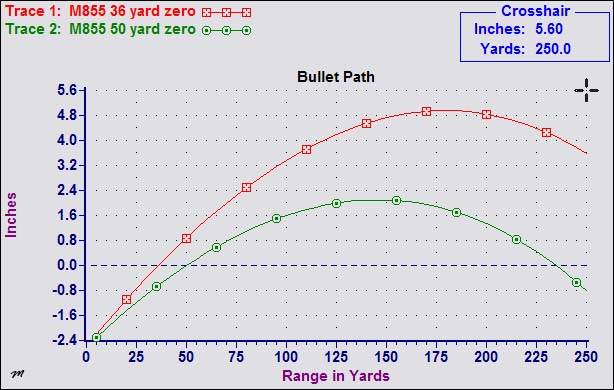
The 36 yard zero was originally nothing more than a field expedient distance (near zero) for obtaining a 300 yard far zero when using the M16A2 with its 20” barrel firing M855.

Pop quiz.
What is the most commonly missed target on the US Army 300 meter pop-up range, when using a 300 meter zero?
a.) 50 meter target
b.) 150 meter target
c.) 300 meter target
d.) None of the above
AR-15 Zeros and Trajectories
The 100 yard zero with a .223/5.56mm AR-15 carbine is a unique trajectory in that the bullet just “kisses” the line of sight at 100 yards and rides along it for approximately 10 yards before dropping back down below the line of sight. (Technically, the bullet does travel above the line of sight, but by only 0.010”; a fraction of the diameter of the bullet itself.)
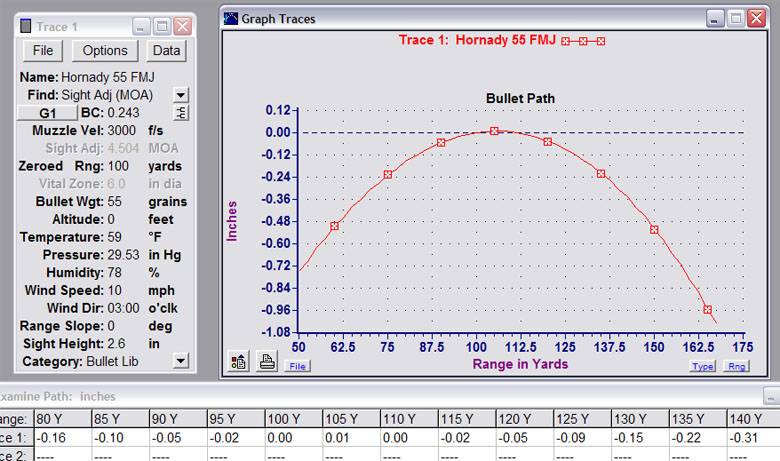
For all other zeroing schemes, there are going to be two points were the bullet crosses the line of sight; the near-zero and the far-zero. For the near-zero, the bullet will cross the line of sight while traveling upward from the muzzle toward the apogee or “maximum ordinate,” its highest point of travel. For the far-zero, the bullet will cross the line of sight while traveling downward from the maximum ordinate.
Now, when assigning a name to a particular zeroing scheme, it would be helpful if that name gave descriptive information about that particular zero; that is, the name should give us information about the trajectory and how it is unique and differs from other trajectories.
As a point of reference, the Santose Improved Battlesight Zero is often referred to as a 50/200 yard zero, however this is incorrect. It is actually a 50 yard/200 meter zeroing scheme; and this is only with a very few particular combinations of bullet weight, barrel length/muzzle velocity and height of sights above the bore. As an example, a 20” barreled AR-15 A2 firing 62 grain M855 will not match the 50 yard/200 meter IBZ. Neither will a 16" barreled RECCE firing 77 grain MK262, nor a 14.5” barreled M4 carbine firing the 70 grain 5.56mm Optimized “Brown Tip” load. The same concept applies when people refer to a 50/225 yard zero. Only a very few specific combinations of bullet weight, barrel length/muzzle velocity and height of sights above the bore will match that description.
What this is all leading up to is this; except for a very few specific combinations of bullet weight, barrel length/muzzle velocity and height of sights above the bore, a 50 yard zero is a different zero than a 200 yard zero. For a 200 yard zero, we know that this trajectory will produce a far-zero in which the bullet will cross the line of sight at 200 yards in its downward travel from the maximum ordinate. (It is physically impossible to produce a 200 yard near-zero with any of the commonly available loads and barrels lengths used in .223/5.56mm AR-15s.) Other than for a very few specific combinations of bullet weight, barrel length/muzzle velocity and height of sights above the bore, the near-zero of the 200 yard zero will not be at 50 yards.
Conversely, a 50 yard zero tells us that this trajectory will have a near-zero in which the bullet crosses the line of sight at a distance of 50 yards in its upward travel to the maximum ordinate. For those who think that a zeroing scheme must be named after its far-zero, it is physically impossible to produce a far-zero of 50 yards with any of the commonly used loads and barrel lengths in .223/5.56mm AR-15s. The 50 yard zero can only be the near-zero.
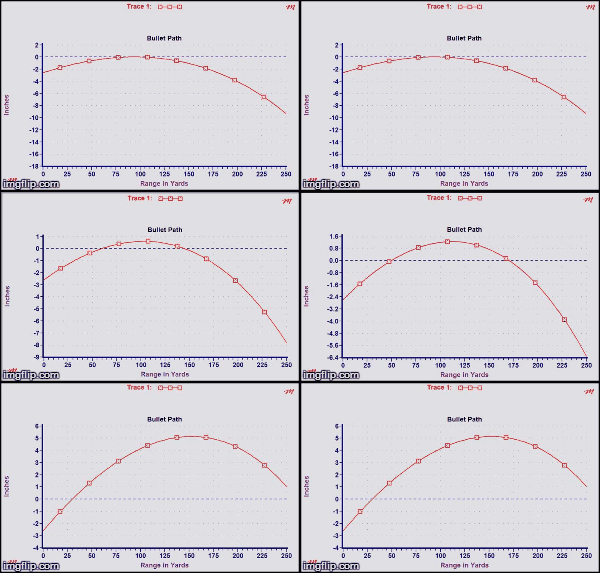
Here are a couple of illustrations to aid in understanding some of the concepts described above. Lets start with the 100 yard zero as a reference point. As described above, with a 100 yard zero, the bullet’s trajectory just “kisses” the line of sight at 100 yards. Now, let’s increase the elevation setting of the sights/scope. As this is done, the near-zero can only move closer and closer to the muzzle. Concomitantly, the far-zero moves farther and farther away from the muzzle.
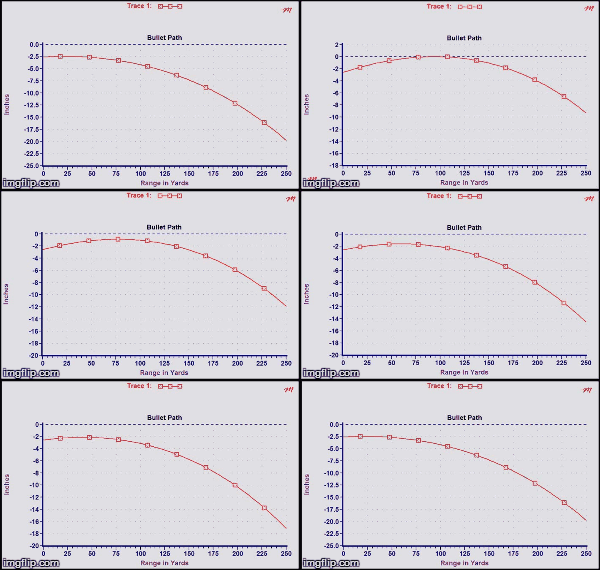
For the next illustration, we’ll start with the 100 yard zero again, only this time let’s decrease the elevation setting of the sights/scope. As this is done, the bullet’s trajectory can only fall away from the line of sight. The bullet will never cross the line of sight again; no zero at all.
Other than for a very few specific combinations of bullet weight, barrel length/muzzle velocity and height of sights above the bore, the far-zero of the 50 yard zero will not be at 200 yards; and for all practical purposes it matters not one bit. Whether the bullet crosses the line of sight for the second time (far-zero) at 189 yards, 200 yards, 215 yards or 225 yards will not make the slightest bit of difference in the practical application of the AR-15 as a defensive weapon. In each case we will be holding the same POA (beyond CQB distances) and know that we will be hitting within approximately 2 inches above or below that POA out to 200 yards (or farther depending upon barrel length and load.) You should have an idea what your actual far-zero is when using a 50 yard zero and confirm such at distance when possible, but again it’s most likely not going to be a 200 yard far-zero and again it does not need to be.
Choose your zeroing scheme based on the pertinent facts; not nonsense about “shooting through a cone.” When shooting at human targets, in the grand scheme of things there isn’t going to be any practical difference between a point of impact that has a negative deviation from the point of aim, (e.g. the bullet strikes 1.5” below the point of aim) and a point of impact that has an equal positive deviation from the point of aim (e.g. the bullet strikes 1.5” above the point of aim.) In other words, the absolute value of the point of impact from the point of aim (how far the point of impact deviates from the point of aim, regardless of whether it is a positive or negative deviation) is what we need to be concerned about. Therefore, one of the main points to consider when choosing a battle-sight-zero is this: What zeroing scheme produces the smallest absolute values for the deviations of the points of impact from the point of aim, over the distance that we reasonably expect to engage a human target in our intended usage?
The chart below illustrates the above concept. The chart compares the absolute values of the deviations of the points of impact from the point of aim (0.0 inches on the graph being the point of aim/line of sight) for a 50-yard-zero and a 100-yard-zero, using Hornady 5.56 TAP T2 ammunition.
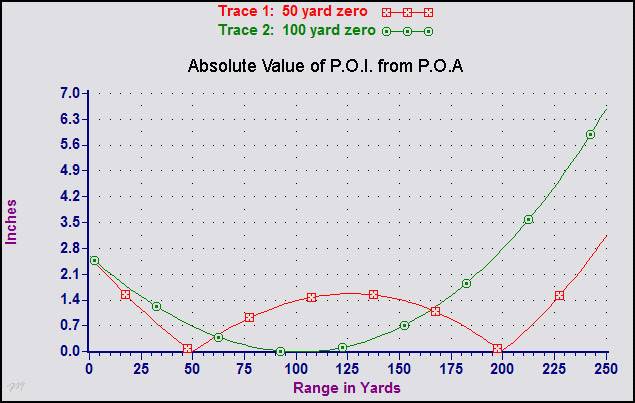
As you can see in the graph above, from the muzzle (0 yards) to approximately 62 yards, the 50-yard-zero has a slight advantage over the 100-yard-zero. Between the distances of 62 yards and 165 yards, the 100-yard-zero has the advantage. From the distance of 165 yards out to the 250 yards shown in the graph, the 50-yard-zero has a distinct advantage over the 100-yard-zero.
Now, let’s add the 36 yard zero into the mix.

From the muzzle to approximately 42 yards, the 36 yard zero has a slight advantage over the 50 yard zero. From 50 yards out to approximately 235 yards, the 50 yard zero has a distinct advantage over the 36 yards zero. It isn’t until shooting past the distance of approximately 235 yards that the 36 yard zero regains any advantage over the 50 yard zero. Choose your zeroing scheme based on the pertinent facts.
Some reference material. Except where noted, all barrel lengths are 20 inches
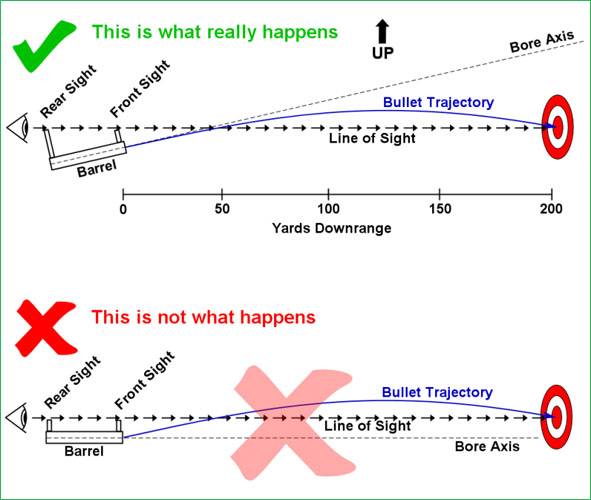
Courtesy of zrxc77
.
.
.
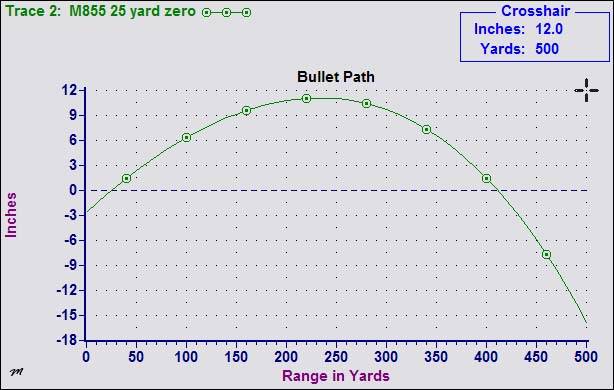
M855 25 yard zero
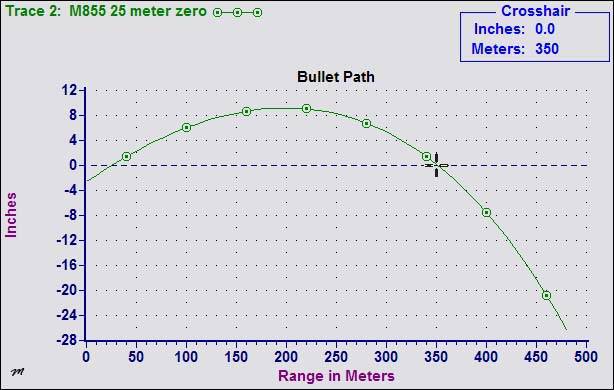
M855 25 meter zero
M855 36 yard vs 100 yard zero
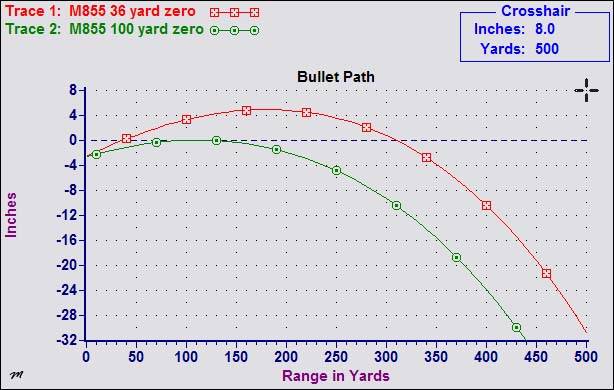
M855
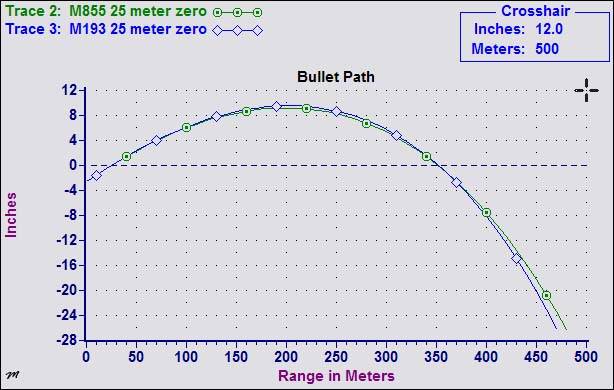
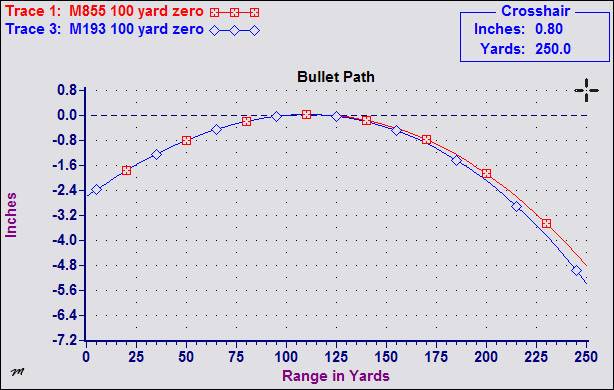
M855 and M193 25 meter zero
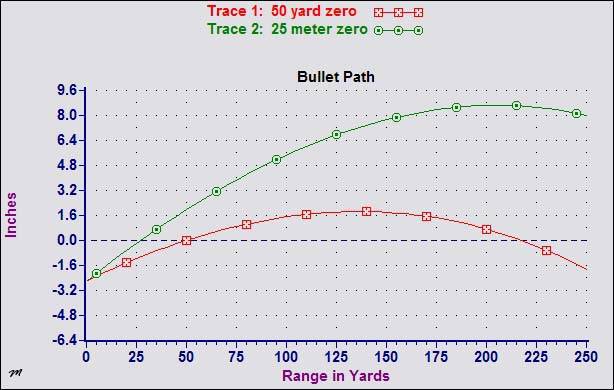
M855 and M193 50 yard zero from 16” barrel
M193 25 meter, 50 yard and 100 yard zeros from 16" barrel
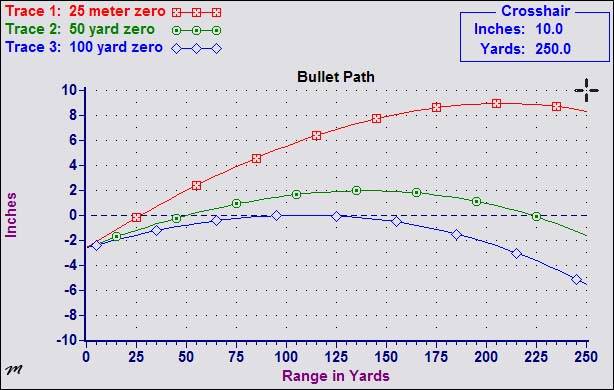
100 yard zero
25 meter vs 50 yard zero, M855 from 16” barrel
25 meter vs 50 meter zero , M193 from 16" barrel
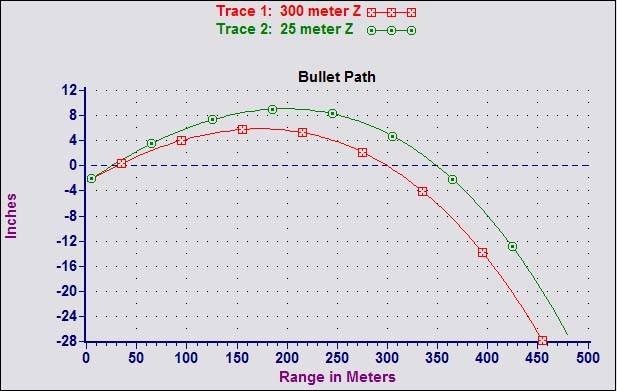
M855 300 meter zero
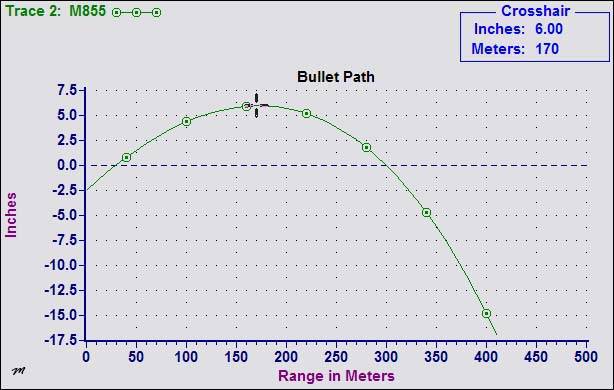
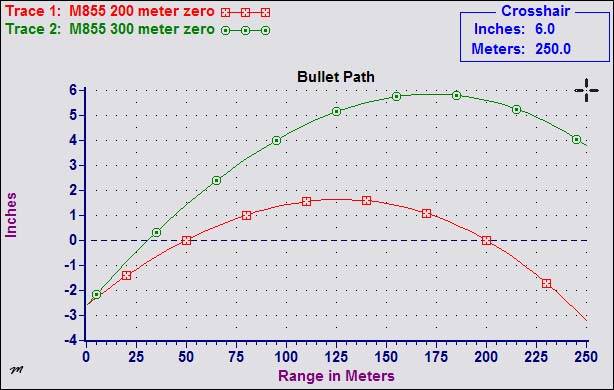
M855 200 meter vs 300 meter zeros
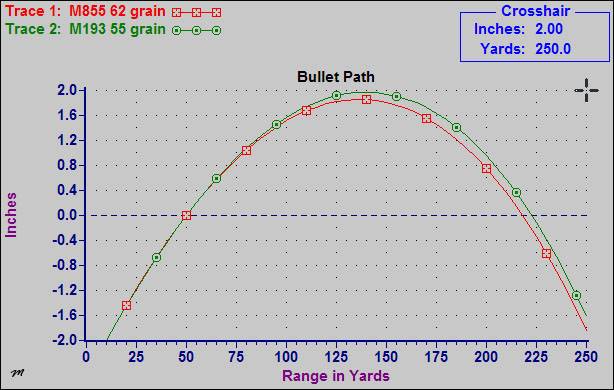
M855 36 yard vs 50 yard zeros